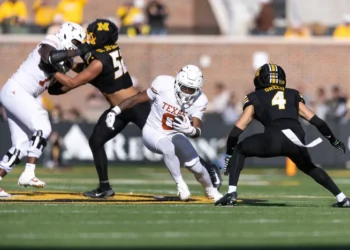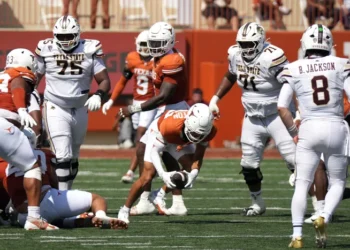



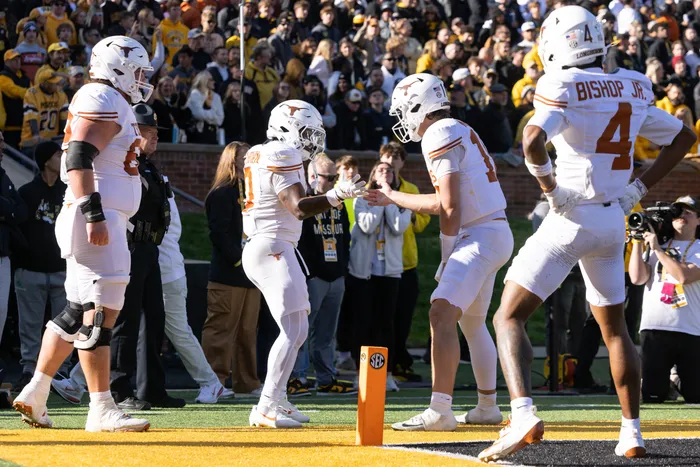
The Longhorns ability to extend their own possessions and end Missouri’s provides a clear standard for the next road test.
The biggest difference in a close football game is often the opportunity to run another play.
Texas created that advantage at Missouri.
The Longhorns converted six of 13 third downs in their 34–20 victory, while holding the Tigers to three conversions in 16 attempts. That gap helped Texas sustain possessions and repeatedly force Missouri to start over.
It is a formula the Longhorns need to carry to LSU this weekend in Baton Rouge.
Offensively, third-down success starts before third down. Texas must avoid allowing negative plays and missed assignments to turn routine possessions into obvious passing situations.
The objective is to give Arch Manning options. A manageable distance keeps more of the playbook available and makes the defense account for more than one way to move the chains.
Execution then has to match the situation. Protection must hold long enough for the route to develop. Receivers must understand where the first-down marker sits. Manning must identify the available answer without treating every conversion attempt as an opportunity for a highlight.
Defensively, Texas needs the same connection between early downs and finishing downs.
Stopping a run or limiting a completion has greater value when the defense follows it with a third-down stop. Pressure must remain coordinated with coverage, and defenders have to finish tackles before short gains become conversions.
Missouri’s limited third-down success gave Texas repeated opportunities to regain possession. That is a foundation worth building on.
It does not mean every problem is solved. Each opponent presents different protection schemes, route combinations and ways to attack a defense’s leverage.
But the assignment remains clear as Texas prepares for another demanding road environment.
Keep the offense on the field. Get the defense off it. Make the next possession belong to the Longhorns.