



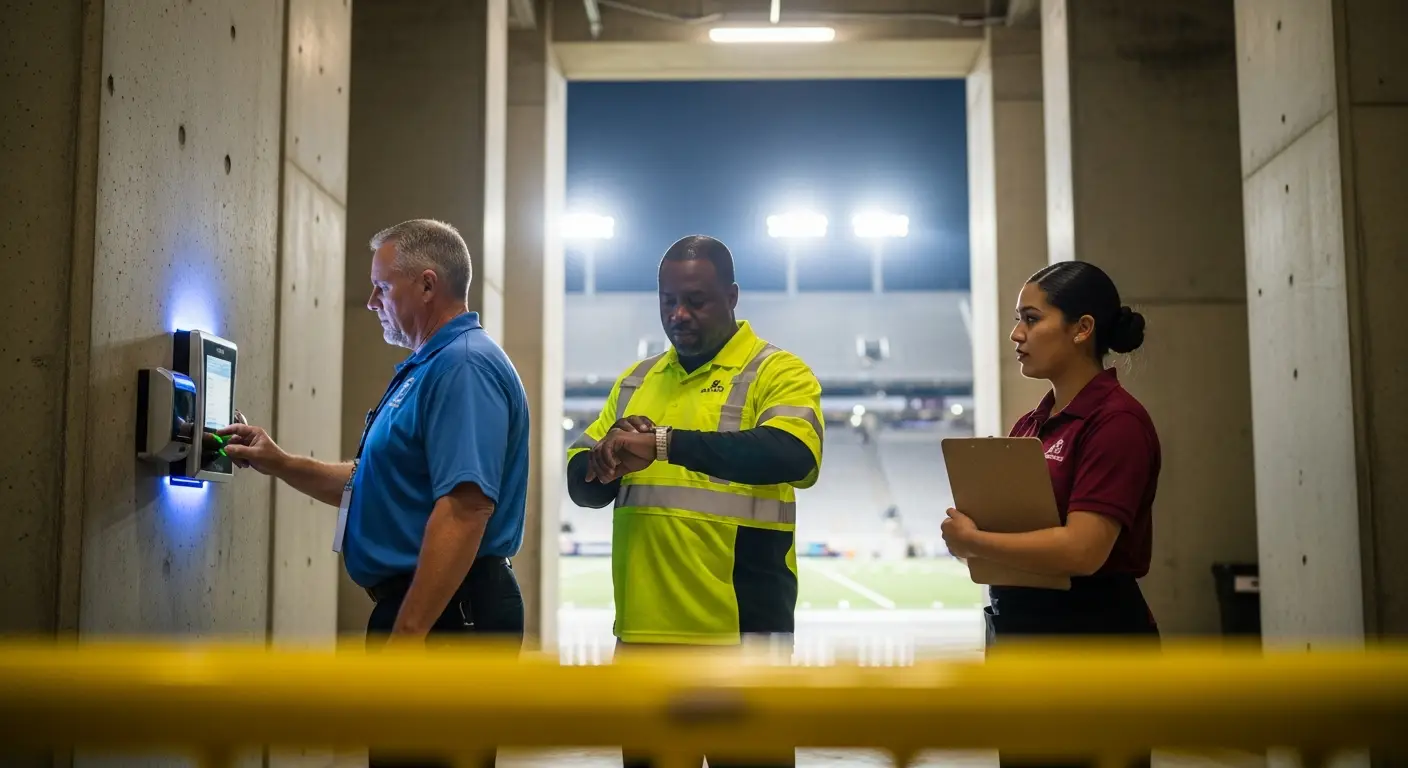
Late kickoffs, night games, and weekend concerts at Texas venues almost always mean extra pay for the people keeping things running. But here’s the part most workers miss: if you’re nonexempt and you earn a shift differential for those hours, that extra pay usually has to be rolled into your overtime calculation under the federal Fair Labor Standards Act.
Texas follows this federal law for its main overtime rules, which matters quite a bit if you’re working around Darrell K Royal-Texas Memorial Stadium, Moody Center, or any of the other major event venues across the state. Schedules for game-day staff regularly exceed 40 hours during football weekends, doubleheader events, or back-to-back setup and cleanup shifts. Sound familiar?
How Does Overtime Work for Texas Stadium Workers?
Texas doesn’t have a separate overtime system for most private-sector workers, so the FLSA controls how employers calculate pay. If you’re nonexempt, you’re entitled to 1.5 times your regular rate for every hour worked beyond 40 in a single workweek. It’s the workweek (not the individual day) that serves as the key unit for this calculation.
And just because you’re salaried doesn’t mean overtime is off the table. The U.S. Department of Labor recently rescinded its 2024 overtime rule, restoring the 2019 salary threshold for white-collar exemptions. That means the current federal baseline has reverted to the older threshold of $684 per week. Even so, exemption still depends heavily on your specific job duties, not just how you’re paid.
Does Shift Differential Count Toward Overtime?
In most cases, yes. Your overtime rate is built on your “regular rate” of pay, not simply your base hourly wage. The regular rate captures most compensation that is directly tied to the work you actually perform.
Night-shift differentials are generally included in that regular rate. Some true premium payments for weekend or holiday work can be excluded, but only when they meet narrow statutory conditions. Think of it like the difference between a bonus your employer chooses to give you at year’s end versus a premium you earn every time you clock in for the graveyard shift; the second one almost always counts.
If you want a more detailed breakdown of how shift differential pay is included in overtime in Texas, that explainer is worth your time.
Under federal guidance, non-discretionary compensation tied to work generally must be included in regular-rate calculations. For context, in related industries like Houston healthcare, night differentials often run 10 to 20 percent of base pay, which shows how meaningful these add-ons can become over a busy week (especially one packed with back-to-back events).
Where Payroll Errors Happen on Game Day
Errors most often occur when workers juggle multiple roles at different rates within the same week. Picture this: you work 20 hours in parking, 18 hours in concessions, and 8 hours doing overnight cleanup. Employers frequently undercalculate overtime in these situations by ignoring the premium portion and skipping the weighted-average math entirely.
These mistakes are surprisingly common across the state. The Texas Workforce Commission received over 15,000 wage complaints in fiscal year 2024, the highest level since at least 2016. During the same timeframe, state labor authorities recovered over $10 million in unpaid compensation following formal investigations into roughly 12,400 workplace compliance cases.
State enforcement is also stretched incredibly thin. As of May 2025, Texas had only 68 federal wage-and-hour investigators, roughly one per 232,000 workers. So if you’re waiting for someone to catch the error for you, you could be waiting a while.
Here are some common warning signs to look for on your pay stub:
- Overtime calculated from your base pay only, ignoring differentials
- A separate line for shift differential that never touches the overtime rate
- Blended schedules with no weighted-average calculation in sight
- Weekend premiums paid at straight time only
- Hours are split across different event roles without all earnings being combined into one regular rate
Texas Stadium Worker Examples
To make the legal rules concrete, here’s a look at how different stadium roles typically handle extra pay. Not every scenario is clear-cut, but the pattern is consistent enough to be useful.
| Role | Typical Event Scenario | Extra Pay Type | Usually Counts Toward Overtime? | Why |
| Security staff | Late football game ends after midnight | Night differential | Yes | Pay tied to undesirable hours worked |
| Concessions worker | Saturday game rush | Weekend premium | Often yes | Unless it qualifies for a narrow statutory premium exclusion |
| Cleanup crew | Overnight turnover after a concert | Overnight premium | Yes | Part of the regular rate in most cases |
| Parking attendant | Holiday event | Holiday premium | Depends | May be excludable only if it meets FLSA premium rules |
| Warehouse/loading crew | Pre-event overnight unload | Shift differential | Yes | Additional work-based compensation |
| Hospitality/medical support | Back-to-back event weekend | Extra hourly premium | Usually yes | Nonexempt compensation generally enters regular-rate math |
Here’s a quick example to put numbers to it. Say a stadium cleanup worker earns $16 an hour and picks up a $2 overnight differential. If that worker logs 45 hours in one workweek and 15 of those hours are premium-paid, the calculation changes. The overtime math should reflect the higher blended regular rate, not just the $16 base pay. That difference might look small on a single check, but over a full football season, it adds up to real money.
What About Salaried Leads, Coordinators, or Supervisors?
Some event workers are salaried and exempt, but plenty aren’t. A title like “supervisor” or “coordinator” doesn’t automatically eliminate overtime eligibility, no matter what your employer might tell you.
The DOL rescission restored the $684-per-week standard salary threshold and prior exemption framework. Misunderstandings are particularly common among operations supervisors and hospitality leaders, who often assume that being paid a fixed salary automatically waives their right to mandatory overtime compensation.
Duties still matter under the law. Recent DOL guidance also confirmed that some exempt employees can perform nonexempt-type tasks without automatically losing exempt status, depending on their primary duty. So it’s not as simple as “I sometimes stock shelves, therefore I get overtime.”
What Should You Do If the Numbers Look Off?
Start by saving every pay stub and keeping personal records of your hours and job assignments. You’d be surprised how many workers don’t do this until there’s already a dispute. Compare your printed overtime rate to the actual blended pay you earned during that specific workweek, and flag any discrepancy.
If you feel comfortable, raise the issue internally with your payroll coordinator first. You can also consider reaching out to the Texas Workforce Commission, the U.S. Department of Labor, or seeking legal advice if the problem keeps recurring.
Around 12,000 Texans were reportedly owed $8 million in back wages, according to a February 2024 DOL report, averaging about $662 per worker. Small weekly underpayments might seem trivial in the moment, but they can add up to significant amounts by the end of a football season.
The Bottom Line for Texas Event Workers
For most nonexempt Texas stadium workers, the shift differential usually counts toward overtime. Night premiums are the clearest example of extra pay that must be factored into your regular rate, and they’re the ones most commonly left out of the math.
Some weekend or holiday premiums can be treated differently, but only under narrow statutory rules. In a sports setting full of late nights and irregular schedules, small payroll errors compound quickly. It’s worth checking the math on every pay stub, especially during those packed fall weekends when you’re pulling double duty across multiple roles.


![Everything you need to know about the Oklahoma Sooners football team [VIDEO]](https://hornsports.com/wp-content/uploads//2023/10/bvUSATSI_11258509_168380999_lowres.jpg.683ae43b6bee93376423f9df377fb4e5-120x86.jpg)