

Sirhornsalot
**The Official Horn Sports Landscaper and Landscap
- Joined
- Nov 6, 2013
- Messages
- 34,929
I'll start this one off with a few items that I've run into and thought I'd pass on. I hope everyone is enjoying the spring season and have wiped off the winter!
DON'T WAIT TO MOW NEXT YEAR
1. Coming out of winter, many homeowners will not mow their lawn because their lawn grass has not emerged from dormancy. A few weeds predictably come in and grow to impressive size. Yet, still no mowing.
Do not wait on your turf to come out of dormancy before starting the mowing season off. If you allow weeds to grow and mature and then seed-out, you're helping propagate the weed population in your lawn. Go ahead and mow, mow short in that early period of the season. That will help keep the weeds from multiplying prior to the turf grass coming out of dormancy . . . even if you are spraying weeds during that time.
BLUE ANYONE?
2. Sharing an emailed question from this week:
"Dear SHA, My wife is upset with me. She sent me to the nursery, told me to come back with some blue flowers. I came back with nothing. What can I do?"
Blue flowers are a problem, believe it or not. Mother Nature creates all kinds of colors in her flora, but blue is one of the more tougher to find on her pallet. I have a friend here in the Metroplex who crossbreeds Daylilies to create new varieties. Even with his skills, knowledge and experience - blue is a color he can't seem to create. The pigment just isn't naturally available.
That said, here are a few plants that will bloom the color blue.
A. Blue Daze - a small dime-sized blue bloom. Grows up to 18 inches high and will bloom off and on all summer. The more sun it gets, the more it blooms.

B. Texas Blue Bells - Relatively tough to find despite being a native Texas flower. I've found these at Calloways from time to time. They will bloom for a few months and are spectacular when they do. I don't plant many because the short blooming time is not something that appeals to many of our customers.

C. Hydrangea - Endless Summer Hydrangea is a nice medium blue. If you're in Austin, DFW, or San Antonio - plant these on the east or north side of your home so that it doesn't get the afternoon-evening sun. In Houston, it's so tropical you can plant them wherever you want.
You can change the color of the blooms to pink, however, by increasing the amount of acid in the soil the plant sits in. I've done it, it works.
Hydrangeas will literally tell you when they need water as they will "pout" and droop something pitiful. Water them when you see this. Stand there for about 10 minutes and watch as it straightens back up to look robust again.
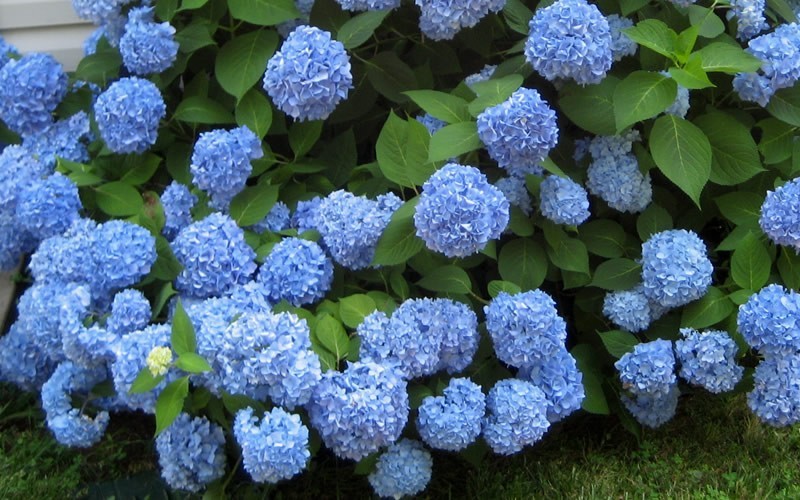
D. Plumbago - A native of Australia, this plant is very drought tolerant and blooms are similar to that of a Hydrangea. Their drawback is that they can look at little gangly but when planted among other flowers, they look great. They are not constant bloomers, but will bloom on and off through the summer.

DON'T BE FOOLED - if you're strict about your colors, then don't be fooled by the "blue" petunias (they're not blue, they're purple) or light blue petunias (they're gray, not blue) and Blue Salvia is purple, not blue.
DON'T WAIT TO MOW NEXT YEAR
1. Coming out of winter, many homeowners will not mow their lawn because their lawn grass has not emerged from dormancy. A few weeds predictably come in and grow to impressive size. Yet, still no mowing.
Do not wait on your turf to come out of dormancy before starting the mowing season off. If you allow weeds to grow and mature and then seed-out, you're helping propagate the weed population in your lawn. Go ahead and mow, mow short in that early period of the season. That will help keep the weeds from multiplying prior to the turf grass coming out of dormancy . . . even if you are spraying weeds during that time.
BLUE ANYONE?
2. Sharing an emailed question from this week:
"Dear SHA, My wife is upset with me. She sent me to the nursery, told me to come back with some blue flowers. I came back with nothing. What can I do?"
Blue flowers are a problem, believe it or not. Mother Nature creates all kinds of colors in her flora, but blue is one of the more tougher to find on her pallet. I have a friend here in the Metroplex who crossbreeds Daylilies to create new varieties. Even with his skills, knowledge and experience - blue is a color he can't seem to create. The pigment just isn't naturally available.
That said, here are a few plants that will bloom the color blue.
A. Blue Daze - a small dime-sized blue bloom. Grows up to 18 inches high and will bloom off and on all summer. The more sun it gets, the more it blooms.
B. Texas Blue Bells - Relatively tough to find despite being a native Texas flower. I've found these at Calloways from time to time. They will bloom for a few months and are spectacular when they do. I don't plant many because the short blooming time is not something that appeals to many of our customers.
C. Hydrangea - Endless Summer Hydrangea is a nice medium blue. If you're in Austin, DFW, or San Antonio - plant these on the east or north side of your home so that it doesn't get the afternoon-evening sun. In Houston, it's so tropical you can plant them wherever you want.
You can change the color of the blooms to pink, however, by increasing the amount of acid in the soil the plant sits in. I've done it, it works.
Hydrangeas will literally tell you when they need water as they will "pout" and droop something pitiful. Water them when you see this. Stand there for about 10 minutes and watch as it straightens back up to look robust again.
D. Plumbago - A native of Australia, this plant is very drought tolerant and blooms are similar to that of a Hydrangea. Their drawback is that they can look at little gangly but when planted among other flowers, they look great. They are not constant bloomers, but will bloom on and off through the summer.
DON'T BE FOOLED - if you're strict about your colors, then don't be fooled by the "blue" petunias (they're not blue, they're purple) or light blue petunias (they're gray, not blue) and Blue Salvia is purple, not blue.