

Welcome to the HornSports Forum
By registering with us, you'll be able to discuss, share and private message with other members of our Texas Longhorns message board community.
SignUp Now!You are using an out of date browser. It may not display this or other websites correctly.
You should upgrade or use an alternative browser.
You should upgrade or use an alternative browser.
**Running College Football Updates Thread**
- Thread starter TFloss32
- Start date


Baron
Well-known member
- Joined
- Jun 21, 2016
- Messages
- 7,560
I agree. Early signing period. Early August. Followed with a dead period that lasts until a week after the NC game.
I think we are talking about two different timelines. You are looking at the next 5-10 years of realignment. I totally understand what you mean about the SEC shouldn't add teams that lower the overall average of quality in the conference.I'm very confused by what you are suggesting. My understanding was that you thought the SEC and B1G should each move to 24 schools, picking up the best available teams.
Let's keep it simple and only consider the SEC.
Currently the SEC will have the following 8 big time major programs: Texas, ou,Georgia, Alabama, aggy,Florida,LSU and Tennessee. And then from there it goes from descent programs down to vandy.
Obviously if you could start over you would eliminate the bottom teams and grab some better ones, or maybe just keep the biggest/best programs and get more similar schools. For better or worse ejecting schools at the bottom, or starting over isn't a serious active dialog at this point in time.
What is a more serious dialog is expansion, which is likely to happen when teams are able to exit the ACC(2036 at the latest). When that happens the SEC will likely still have the existing 16 schools, so the only question is which schools to take. IMHO they should take Florida State, and consider North Carolina and Virginia, but no more, they definitely shouldn't go to 24 teams since that would involve adding teams that would lower the average, which would make the conference less compelling from a per team revenue and schedule excitement perspective.
What exactly are you suggesting?
I was just talking about what things might look like in 15-20 years, a major restructuring that could occur (though by what means, who knows). Essentially reducing down the 128 D1 football teams, that includes 60 power 5 schools, to a league where only the top 48 or so are in play. That 48 team product could be more compelling than the 128 team (or 60 team) product we have now.
Gerry Hamilton discussed this 2 league 24 team super league on OTF this morning. He mentions having the other teams play a spring schedule. But again, this would all be way down the line.

Sirhornsalot
**The Official Horn Sports Landscaper and Landscap
- Joined
- Nov 6, 2013
- Messages
- 34,833
College football has been such a pleasure up to now. I hope they don't screw everything up. Sure would be a shame.
I think we are talking about two different timelines. You are looking at the next 5-10 years of realignment. I totally understand what you mean about the SEC shouldn't add teams that lower the overall average of quality in the conference.
I was just talking about what things might look like in 15-20 years, a major restructuring that could occur (though by what means, who knows). Essentially reducing down the 128 D1 football teams, that includes 60 power 5 schools, to a league where only the top 48 or so are in play. That 48 team product could be more compelling than the 128 team (or 60 team) product we have now.
Gerry Hamilton discussed this 2 league 24 team super league on OTF this morning. He mentions having the other teams play a spring schedule. But again, this would all be way down the line.
The distant future is certainly hard to predict.
Obviously the bottom feeders of the SEC and B1G are not going to leave on their own accord. The conferences are interested in self preservation so are not going to do anything to hasten their demise.
Perhaps there are other ways, but the only way I can imagine that the demise of the conferences is if the bigest revenue schools decided to band together to furthrler maximize their revenue. If this was to happen the top say 16 teams would start a new conference, then the top remaining schools would create the next conference and so on. If this scenario plays out I'm not sure that this would result in less teams, and it's not clear how many conference and non conference games would be played. I think the main changes would be that the rich would get richer, and the concept of a regional conference would be dead.
I think this has already occurred.and the concept of a regional conference would be dead.
Big10 and ACC are now east to west coast and the Big12 is east coast to Arizona. The ACC and Big12 previously had very little east to west spread. The SEC is the only major conference with reasonable geography.
College football used to be a regional sport but as times and technology change, and more money is to be made, it is now a national television product and the conferences are slowly but surely adjusting because of that fact.
I do think football should break apart from other sports. The geographic spread for most other sports just doesn't make sense and is only happening because of football.
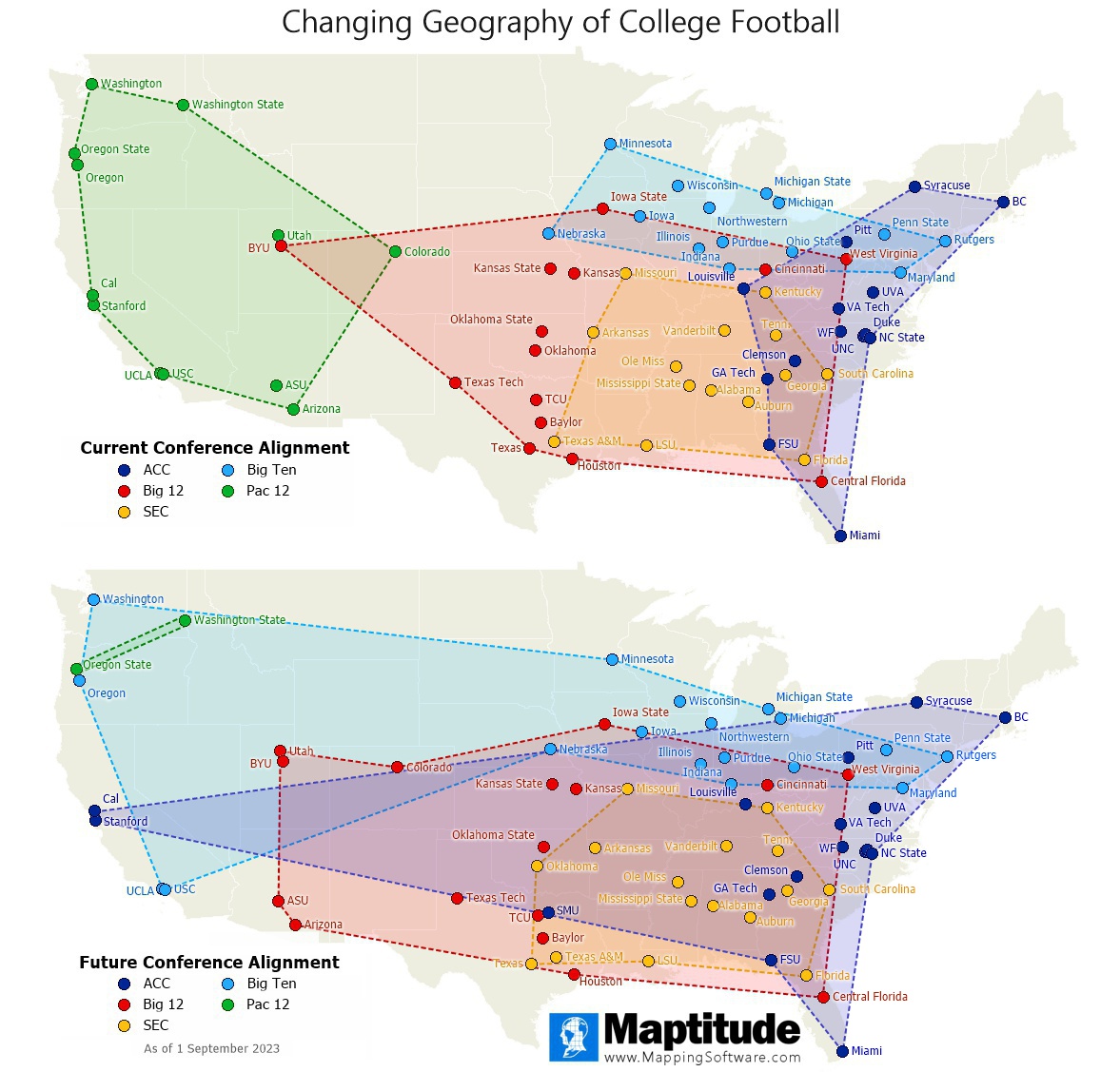
Changing Geography of College Football - Maptitude Infographic
Maptitude mapping software infographic comparing the current and future geographic distribution of college football conferences
www.caliper.com
I think this has already occurred.
Big10 and ACC are now east to west coast and the Big12 is east coast to Arizona. The ACC and Big12 previously had very little east to west spread. The SEC is the only major conference with reasonable geography.
College football used to be a regional sport but as times and technology change, and more money is to be made, it is now a national television product and the conferences are slowly but surely adjusting because of that fact.
I do think football should break apart from other sports. The geographic spread for most other sports just doesn't make sense and is only happening because of football.
Changing Geography of College Football - Maptitude Infographic
Maptitude mapping software infographic comparing the current and future geographic distribution of college football conferenceswww.caliper.com
Geographical conferences has obviously become less of a thing., and the demise of the PAC is a major factor. The SEC is the only major conference where the conference is regional. My point was that if you eliminated all history and start from scratch that geographical considerations would likely be completely gone.
I think if there was a major reset at some point, you could restore some of the geographical sense to things.Geographical conferences has obviously become less of a thing., and the demise of the PAC is a major factor. The SEC is the only major conference where the conference is regional. My point was that if you eliminated all history and start from scratch that geographical considerations would likely be completely gone.
Anything is possible, but that would be a reverse in trend. Both the SEC and B1G expansion were primarily driven by schools wanting to maximize their income, while maintaining a compelling schedule. For the ACC and the B1G and the BIG12 location was mostly ignored. The SEC was able to maintain their regional nature since they were able to do so without any sacrifice.I think if there was a major reset at some point, you could restore some of the geographical sense to things.
If the big money schools want to further increase their income they will create coast to coast league made up of only the teams with the most media value. Each of those schools would come closer to receiving all of the value they are creating, since they would no longer need to subsidize the lower revenue value schools.
Only time will tell, but if I was a betting man I would bet on a major reset being driven by money, not nostalgia.
Last edited:
Baron
Well-known member
- Joined
- Jun 21, 2016
- Messages
- 7,560
I think he meant that a 48 team league would have to go to pod system and then it might be regional again.Anything is possible, but that would be a reverse in trend. Both the SEC and B1G expansion were primarily driven by schools wanting to maximize their income, while maintaining a compelling schedule. For the ACC and the B1G and the BIG12 location was mostly ignored. The SEC was able to maintain their regional nature since they were able to do so without any sacrifice.
If the big money schools want to further increase their income they will create coast to coast league made up of only the teams with the most media value. Each of those schools would come closer to receiving all of the value they are creating, since they would no longer need to subsidize the lower revenue value schools.
Only time will tell, but if I was a betting man I would bet on a major reset being driven by money, not nostalgia.
If there is a reset, then I think the big revenue schools will make it a priority to maximize their revenue. To achieve this I don't see a 48 team league, where everyone gets an equal share. If there is a teered model, then I would think the high revenue schools would play each other more, and the regional mid revenue schools lessI think he meant that a 48 team league would have to go to pod system and then it might be regional again.
Baron
Well-known member
- Joined
- Jun 21, 2016
- Messages
- 7,560
And that's where it will fail again. Someone will get butt hurt over revenue and start a new and smaller league (which would really suck).If there is a reset, then I think the big revenue schools will make it a priority to maximize their revenue. To achieve this I don't see a 48 team league, where everyone gets an equal share. If there is a teered model, then I would think the high revenue schools would play each other more, and the regional mid revenue schools less
If the new conferences were made up of peer schools with similar revenue values, then no butt hurt within the conference. As there is today, lesser conference members will be frustrated to not be in the big boy conference.And that's where it will fail again. Someone will get butt hurt over revenue and start a new and smaller league (which would really suck).
Last edited:





About Us
