

echeese
Premium Members
- Joined
- Nov 22, 2013
- Messages
- 2,474
Stole this from Wiz at OB. . ...he's a goofy shit but actually a good dude.
Anyway, 3 lengthy write ups on how different defensive formations work.
TO/TEXAS' is the 3rd link and will share some below.
http://sportstreatise.com/2018/02/a-glossary-of-modern-defensive-formations-pt-i/
http://sportstreatise.com/2018/02/a-glossary-of-modern-defensive-formations-pt-ii/
http://sportstreatise.com/2018/02/a-glossary-of-modern-defensive-formations-pt-iii/
The 3-2-6 defense
Personnel: Three DL, two LBs, two CBs, four Ss
The 3-2-6 is basically a recognition that the 3-4 isn’t optimal for defending spread offenses and the expansion of a dime package into a base defense. Texas embraced the 3-2-6 last season when it became clear that A) spread offenses didn’t have a great answer for the two-robber coverage and B) Texas was better as an all around defense by playing more versatile athletes (i.e. four safeties) rather than specialists.
I don’t know when exactly the Katy Tigers embraced the 3-2-6 but their legendary 2015 defense played like a 3-2-6 despite utilizing current West Virginia safety Jovanni Stewart as a de-facto DE and the 6-5, 222 pound LB Hunter Stinson as a hybrid LB/safety.
The Tigers evidently start by teaching their outside linebackers as safeties before moving (presumably the bigger, stronger ones) them down to the outside LB spots. This gives them a ton of versatility that I’ll detail here just in how they can handle the dreaded trips formation:
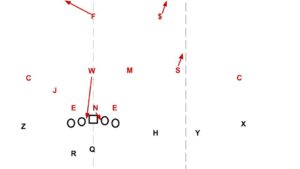
In this call they bring the weak inside-backer up the A-gap, preferably late and disguised, and drop the free safety into cover 2 on the boundary while playing some brand of quarters coverage to the field. Between the nose, WILB, and two DEs the defense is filling all four interior gaps and spilling the ball outside to the middle LB and the two S/LB hybrids I’ve labelled as “S” and “J.”
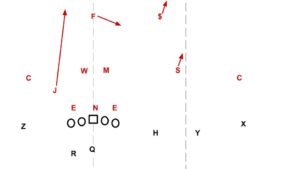
In this call they drop that jack safety deep into cover 2, play cover 2 on the opposite end, and roll the free safety into the “2-robber” role where he’s a free hitter against the run.
The three DL and two inside-backers account for the interior gaps and can easily adjust to any pullers or motion and then that free safety is typically playing downhill and wrecking everything from the robber alignment. It’s essentially the same as an old Tampa-2 defense except the middle linebacker starts the play deep and can come downhill from there. You’re going to be seeing a lot more of this, especially given how successful it was for Texas and Iowa State last season. That robber is a devastating weapon against spread run games which haven’t yet adapted to account for him.
So you can tell that the design of the 3-2-6 is a tad different than the 3-4 even though it often has the same structure, the goal here is more about plugging the interior and spilling the ball to speedy players on the perimeter. It’s also more about having matchup and coverage flexibility in a fashion similar to the 3-3-5 but with an even greater emphasis on using flexible athletes.
Like the other three-down fronts, the 3-2-6 relies heavily on having a really good nose tackle that can control the A-gaps and command and resist a double team. Without that, it unravels. Additionally, it’s finest deployment will come from having versatile and sturdy safeties in the outside LB positions. The 3-2-6 is basically a defense for teams that get amazing nickel play and then ask, “how can we get more out of these guys?” It’ll probably be a mainstay for Texas in the coming years, especially after this 2018 recruiting class that included six top rated DBs, one of whom is 6-4, 200 and born to play a hybrid role.
Anyway, 3 lengthy write ups on how different defensive formations work.
TO/TEXAS' is the 3rd link and will share some below.
http://sportstreatise.com/2018/02/a-glossary-of-modern-defensive-formations-pt-i/
http://sportstreatise.com/2018/02/a-glossary-of-modern-defensive-formations-pt-ii/
http://sportstreatise.com/2018/02/a-glossary-of-modern-defensive-formations-pt-iii/
The 3-2-6 defense
Personnel: Three DL, two LBs, two CBs, four Ss
The 3-2-6 is basically a recognition that the 3-4 isn’t optimal for defending spread offenses and the expansion of a dime package into a base defense. Texas embraced the 3-2-6 last season when it became clear that A) spread offenses didn’t have a great answer for the two-robber coverage and B) Texas was better as an all around defense by playing more versatile athletes (i.e. four safeties) rather than specialists.
I don’t know when exactly the Katy Tigers embraced the 3-2-6 but their legendary 2015 defense played like a 3-2-6 despite utilizing current West Virginia safety Jovanni Stewart as a de-facto DE and the 6-5, 222 pound LB Hunter Stinson as a hybrid LB/safety.
The Tigers evidently start by teaching their outside linebackers as safeties before moving (presumably the bigger, stronger ones) them down to the outside LB spots. This gives them a ton of versatility that I’ll detail here just in how they can handle the dreaded trips formation:
In this call they bring the weak inside-backer up the A-gap, preferably late and disguised, and drop the free safety into cover 2 on the boundary while playing some brand of quarters coverage to the field. Between the nose, WILB, and two DEs the defense is filling all four interior gaps and spilling the ball outside to the middle LB and the two S/LB hybrids I’ve labelled as “S” and “J.”
In this call they drop that jack safety deep into cover 2, play cover 2 on the opposite end, and roll the free safety into the “2-robber” role where he’s a free hitter against the run.
The three DL and two inside-backers account for the interior gaps and can easily adjust to any pullers or motion and then that free safety is typically playing downhill and wrecking everything from the robber alignment. It’s essentially the same as an old Tampa-2 defense except the middle linebacker starts the play deep and can come downhill from there. You’re going to be seeing a lot more of this, especially given how successful it was for Texas and Iowa State last season. That robber is a devastating weapon against spread run games which haven’t yet adapted to account for him.
So you can tell that the design of the 3-2-6 is a tad different than the 3-4 even though it often has the same structure, the goal here is more about plugging the interior and spilling the ball to speedy players on the perimeter. It’s also more about having matchup and coverage flexibility in a fashion similar to the 3-3-5 but with an even greater emphasis on using flexible athletes.
Like the other three-down fronts, the 3-2-6 relies heavily on having a really good nose tackle that can control the A-gaps and command and resist a double team. Without that, it unravels. Additionally, it’s finest deployment will come from having versatile and sturdy safeties in the outside LB positions. The 3-2-6 is basically a defense for teams that get amazing nickel play and then ask, “how can we get more out of these guys?” It’ll probably be a mainstay for Texas in the coming years, especially after this 2018 recruiting class that included six top rated DBs, one of whom is 6-4, 200 and born to play a hybrid role.