


Sirhornsalot
**The Official Horn Sports Landscaper and Landscap
- Joined
- Nov 6, 2013
- Messages
- 34,106
The end of summer is in sight, but there's still much to be considered and done in the landscape during the month of August. Let's get right to them!
Keeping suckers off of Crapes

Ever see this and think to yourself “that just doesn’t look right� Well, you’re right.
Crape Myrtles, as shown in the picture, are trees that have a habit of constantly growing “suckers†at the base of the tree and up and down the trunks. Crapes are supposed to have graceful, bare trunks when properly maintained. The growth at the bottom is commonly called “sucker growth†because its unwanted growth that sucks the minerals and nutrients away from the tree instead of those being sent further up the tree’s canopy.
The result is a tree that looks like a bush. So in essence, trimming off the sucker growth at the base helps make a healthier canopy above because the limbs above will receive those nutrients instead of being intercepted at the base.
Sucker growth will happen quite often during the summer months. That growth should be trimmed off as soon as it appears.
The tree does this as a self-protection instinct. With its lower growth, it can protect it’s root base (soil) from drying out so fast. However, we defy those instincts by keeping them properly trimmed and watered.
Below is an example of a properly maintained Crape Myrtle.

There are other trees in that landscape that will also try to throw up sucker growth. One such offender, the Yaupon Holly, will send it’s growth up through the surrounding soil as well as its trunk base. These should be removed as soon as they appear.
Live Oaks in the Austin area in particular, will send up sucker growth through its root system, sprouting new saplings on an almost constant basis in some cases. Why does this happen and why does it happen in Austin so much more frequently?
Live Oaks feeder roots are constantly searching out nutrients. When soil is nutrient-challenged, new saplings sprout up as a reproductive instinct. In Austin, however, the issue is compounded by the fact that the soil there is shallow and below it is often solid limestone rock. There’s nowhere else for them to go.
You cannot combat this chemically without adverse effects on the mother trees. Keeping the soil replenished with compost on an annual basis will help this as well as supplements such as Ironite and fertilizer.
Air Conditioner Units
Those twigs you might think are weeds around and near your outside air conditioner unit(s)? Those are likely small trees or saplings. In North Texas, odds are that they’ll be Hackberry saplings. The unsuspecting homeowner dismisses them as weeds and since they’re near an AC unit, they’re not a concern.
However, those saplings are a menace. For starters, they will end up as trees. Trees located in the wrong place – at your foundation line and near an AC unit.
As most know, tree roots can be highly problematic for home foundations if the tree is located too close to the home. Additionally, home air conditioner units need to breath to operate properly. Any growth or structures used to hide these unsightly machines need to be at least three feet away from the unit in any direction.
You can hide the AC units using foliage/shrubs or you can use a “partition†style that looks much like a fence. If you do use the partition option, make sure you leave a side unfenced so that repairs can be done and units can be removed/replaced when needed. Also, again, stay three feet away and leaves gaps in the pickets so the units can breath.

Summer Solstice
As most of you know, the Summer Solstice marks the longest day of the year. This year, that day fell on Sunday, June 21st. Each day leading up to that date became longer than the day before. Each day now that passes after that date will be shorter than the day before.
This summer Solstice occurs when the tilt of the earth’s semi-axis is most inclined towards the sun.
I bring this up as it relates to our watering habits that we become used to during the intense heat of summer. On LABOR DAY, you will want to change your water sprinkler start times to 4 a.m. or 5 a.m. start times. As nights become longer/cooler and days become shorter/milder, the conditions that enable turf fungus to appear and thrive. So we combat this by watering in the morning so that the water does not sit on the turf as long.
If you’ll remember, we set these start times earlier this summer for late night starts so that the water spent more time on the turf. On Labor Day, we want to reverse that strategy.
Pre-emergent time
Now is the time to be applying your second of three rounds of pre-emergent to your lawn. Apply in the next week for best results!
As hot as it is, hold off on fertilizing the lawn until the heat breaks and we begin to get rainfall again. Putting down fertilizer in this heat would surely damage a lawn.
The Chinch
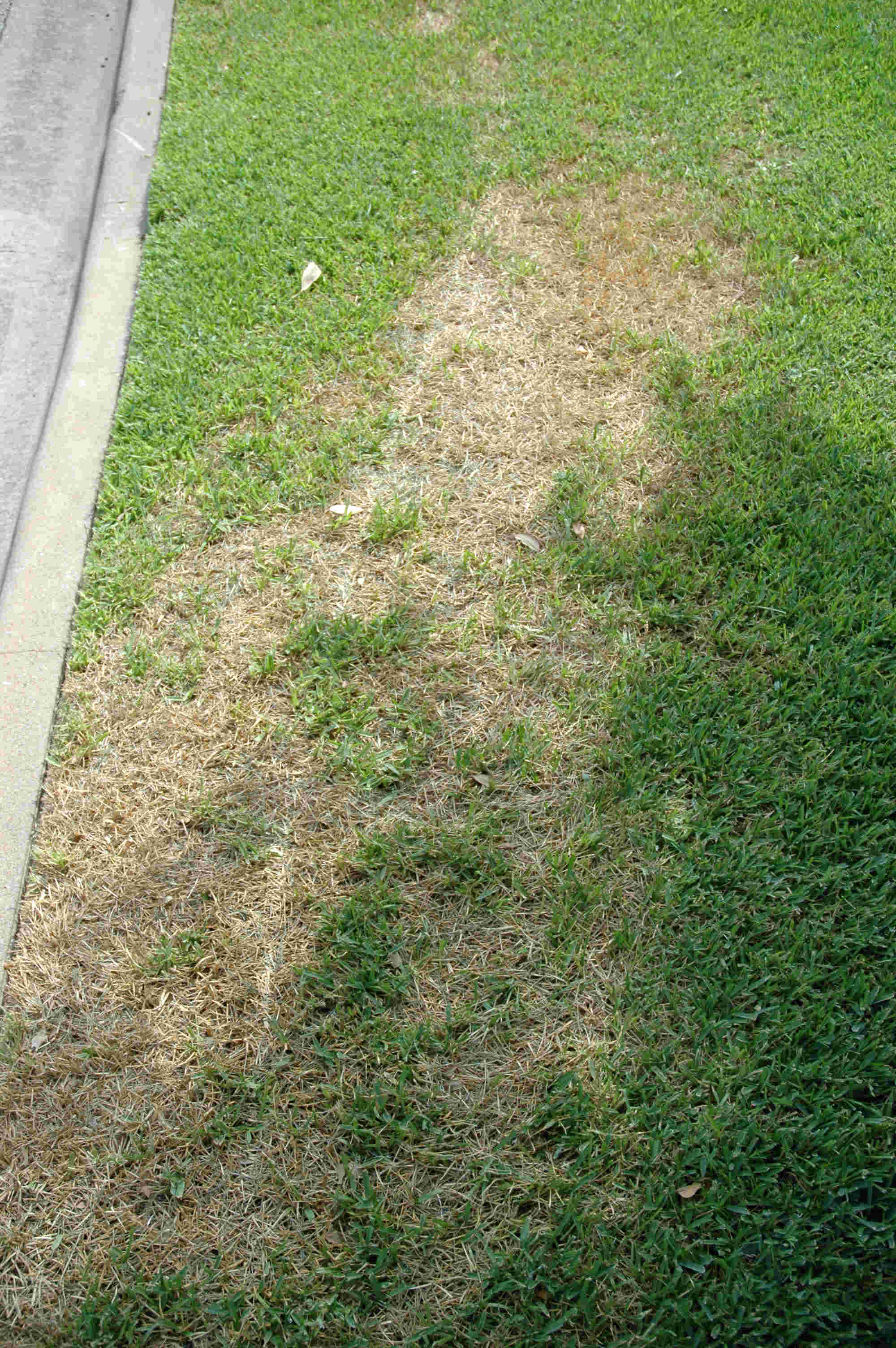
Do not forget that August is the month when Chinch bugs commonly make their strongest appearance of the year. You will be able to recognize their presence by the damage they leave behind. Their damage will likely be found near a concrete, stone or other hot surface that is located near turf. The Chinch bugs enjoy the heat so they gravitate to hot surfaces.
Their damage can be extensive. They will feed on practically any lawn but seem to hit hardest on St Augustine turf.
If you observe this type of damage, contact a landscaper for treatment remedy as soon as possible. A product called Talstar is highly effective on Chinch bugs.
The August Q&A
The following are some questions I’ve fielded recently. Maybe you have a question of your own? If so, fire away.
Question – I have a Burr Oak that is now becoming mature size. I’ve noticed a disfiguration on the side of the tree. I’m scared this might be hurting the tree. It’s funny because it looks like a big tumor.
Answer – That is nothing to worry about. Oak trees are known to grow a “burl†which is where one or more twig buds whose cells continue to multiply but never differentiate so that the twig can elongate and grow into a limb. Burls do not normally cause any harm to the tree and are valued for their grain in furniture making.
Question – I planted several rows of Cherry Laurels. I’ve seen my dogs eating them. Should I be concerned?
Answer – Do not let the dogs eat the Cherry Laurels. The leaves, fruit and seed are known to cause severe discomfort to humans if eaten. I would imagine the same would happen with a dog. The seeds contained within the cherries are poisonous.
Question – I assume it’s too hot to plant right now. When can I plant new plants in my landscape?
Answer – It would be wise to wait until the heat breaks before you plant. You could plant right now but there’s some risk involved because of the intense heat and also because you’ll need to dedicate time each day to providing water to new plants. Most folks either don’t want to dedicate that time or don’t have the time available. In those cases, yes, it’s best to wait until end of August or thereabouts.

Plant of the Month – Croton
Crotons are beautiful plants which are native to Southeast Asia. They are used in landscape beds where seasonal flowers are planted. They make great accent anchors against succulent flowers.
Crotons do not bloom, but instead are favored because their leaves turn from green to red to orange and yellow during the course of their leaf cycle. Unfortunately, they do not make it through our North Texas winters so they do need to be replanted each year.
Keeping suckers off of Crapes
Ever see this and think to yourself “that just doesn’t look right� Well, you’re right.
Crape Myrtles, as shown in the picture, are trees that have a habit of constantly growing “suckers†at the base of the tree and up and down the trunks. Crapes are supposed to have graceful, bare trunks when properly maintained. The growth at the bottom is commonly called “sucker growth†because its unwanted growth that sucks the minerals and nutrients away from the tree instead of those being sent further up the tree’s canopy.
The result is a tree that looks like a bush. So in essence, trimming off the sucker growth at the base helps make a healthier canopy above because the limbs above will receive those nutrients instead of being intercepted at the base.
Sucker growth will happen quite often during the summer months. That growth should be trimmed off as soon as it appears.
The tree does this as a self-protection instinct. With its lower growth, it can protect it’s root base (soil) from drying out so fast. However, we defy those instincts by keeping them properly trimmed and watered.
Below is an example of a properly maintained Crape Myrtle.
There are other trees in that landscape that will also try to throw up sucker growth. One such offender, the Yaupon Holly, will send it’s growth up through the surrounding soil as well as its trunk base. These should be removed as soon as they appear.
Live Oaks in the Austin area in particular, will send up sucker growth through its root system, sprouting new saplings on an almost constant basis in some cases. Why does this happen and why does it happen in Austin so much more frequently?
Live Oaks feeder roots are constantly searching out nutrients. When soil is nutrient-challenged, new saplings sprout up as a reproductive instinct. In Austin, however, the issue is compounded by the fact that the soil there is shallow and below it is often solid limestone rock. There’s nowhere else for them to go.
You cannot combat this chemically without adverse effects on the mother trees. Keeping the soil replenished with compost on an annual basis will help this as well as supplements such as Ironite and fertilizer.
Air Conditioner Units
Those twigs you might think are weeds around and near your outside air conditioner unit(s)? Those are likely small trees or saplings. In North Texas, odds are that they’ll be Hackberry saplings. The unsuspecting homeowner dismisses them as weeds and since they’re near an AC unit, they’re not a concern.
However, those saplings are a menace. For starters, they will end up as trees. Trees located in the wrong place – at your foundation line and near an AC unit.
As most know, tree roots can be highly problematic for home foundations if the tree is located too close to the home. Additionally, home air conditioner units need to breath to operate properly. Any growth or structures used to hide these unsightly machines need to be at least three feet away from the unit in any direction.
You can hide the AC units using foliage/shrubs or you can use a “partition†style that looks much like a fence. If you do use the partition option, make sure you leave a side unfenced so that repairs can be done and units can be removed/replaced when needed. Also, again, stay three feet away and leaves gaps in the pickets so the units can breath.
Summer Solstice
As most of you know, the Summer Solstice marks the longest day of the year. This year, that day fell on Sunday, June 21st. Each day leading up to that date became longer than the day before. Each day now that passes after that date will be shorter than the day before.
This summer Solstice occurs when the tilt of the earth’s semi-axis is most inclined towards the sun.
I bring this up as it relates to our watering habits that we become used to during the intense heat of summer. On LABOR DAY, you will want to change your water sprinkler start times to 4 a.m. or 5 a.m. start times. As nights become longer/cooler and days become shorter/milder, the conditions that enable turf fungus to appear and thrive. So we combat this by watering in the morning so that the water does not sit on the turf as long.
If you’ll remember, we set these start times earlier this summer for late night starts so that the water spent more time on the turf. On Labor Day, we want to reverse that strategy.
Pre-emergent time
Now is the time to be applying your second of three rounds of pre-emergent to your lawn. Apply in the next week for best results!
As hot as it is, hold off on fertilizing the lawn until the heat breaks and we begin to get rainfall again. Putting down fertilizer in this heat would surely damage a lawn.
The Chinch
Do not forget that August is the month when Chinch bugs commonly make their strongest appearance of the year. You will be able to recognize their presence by the damage they leave behind. Their damage will likely be found near a concrete, stone or other hot surface that is located near turf. The Chinch bugs enjoy the heat so they gravitate to hot surfaces.
Their damage can be extensive. They will feed on practically any lawn but seem to hit hardest on St Augustine turf.
If you observe this type of damage, contact a landscaper for treatment remedy as soon as possible. A product called Talstar is highly effective on Chinch bugs.
The August Q&A
The following are some questions I’ve fielded recently. Maybe you have a question of your own? If so, fire away.
Question – I have a Burr Oak that is now becoming mature size. I’ve noticed a disfiguration on the side of the tree. I’m scared this might be hurting the tree. It’s funny because it looks like a big tumor.
Answer – That is nothing to worry about. Oak trees are known to grow a “burl†which is where one or more twig buds whose cells continue to multiply but never differentiate so that the twig can elongate and grow into a limb. Burls do not normally cause any harm to the tree and are valued for their grain in furniture making.
Question – I planted several rows of Cherry Laurels. I’ve seen my dogs eating them. Should I be concerned?
Answer – Do not let the dogs eat the Cherry Laurels. The leaves, fruit and seed are known to cause severe discomfort to humans if eaten. I would imagine the same would happen with a dog. The seeds contained within the cherries are poisonous.
Question – I assume it’s too hot to plant right now. When can I plant new plants in my landscape?
Answer – It would be wise to wait until the heat breaks before you plant. You could plant right now but there’s some risk involved because of the intense heat and also because you’ll need to dedicate time each day to providing water to new plants. Most folks either don’t want to dedicate that time or don’t have the time available. In those cases, yes, it’s best to wait until end of August or thereabouts.
Plant of the Month – Croton
Crotons are beautiful plants which are native to Southeast Asia. They are used in landscape beds where seasonal flowers are planted. They make great accent anchors against succulent flowers.
Crotons do not bloom, but instead are favored because their leaves turn from green to red to orange and yellow during the course of their leaf cycle. Unfortunately, they do not make it through our North Texas winters so they do need to be replanted each year.
Last edited by a moderator:


 ) is just outside Brenham and we have had some 100+ plus days - like everyone else. My yard guys fertilized them with Osmocote about two months ago. But they did the same last year and the plants did fine. And, no, the deer haven't been peeing in them. Our yard is fenced to prevent deer and pigs.