


Sirhornsalot
**The Official Horn Sports Landscaper and Landscap
- Joined
- Nov 6, 2013
- Messages
- 34,478
Create a living visual barrier for backyard privacy!
You’ve bought a beautiful new home. You love the landscape. You love the outdoor living space. It becomes your little paradise. Maybe you build a swimming pool and add a hot tub. Next, you build an outdoor kitchen so you can cook outdoors while enjoying your home life.
Then, the next thing you know a home is built next door. And then another one is built on the other side of you. Suddenly you realize you’ve lost your privacy that you once so enjoyed.
What do you do?
An initial thought might be changing your black iron fencing to a wooden picket fence. Some Homeowners Associations won’t allow this. For some, they may think changing from a six-foot fence to an eight-foot fence will do the trick.
If the homes next door are two-story, raising the fence height won’t help much.
One idea that has proven to be a winner time and again is the living visual barrier. They are both beautiful and effective. Using evergreen selections will assure you of having privacy all year long.
Here are some good choices for visual barriers:

Spartan Junipers (above) – My favorite juniper because of it’s deep, deep green color. It has a columnar growth habit which will top out at around 35-40 feet. They are easy to grow because, let’s face it – it’s a juniper and they love Texas. Once established, they are drought tolerant. Moderately fast growers.

Eastern Red Cedar (above) – Red Cedars are native to our area, so they do very well here. They are efficient at this visual barrier stuff because they can be just as wide as they are tall. They’ll go 30-35 feet in height and are moderately fast growers. They are drought tolerant and very efficient with getting water. You do want to make sure no one in the home is allergic to cedars before planting these.

Savannah Holly (above) – One of my favorite hollies, among many types of hollies! Savannahs grow well here but they should be planted with acidic planting mix. They are fast growers and go to 30+ feet tall and 8-9 feet wide. When planted in a full sun location, their foliage will be dense, dark green and feature attractive red berries.

Madelyn Cypress (above) – The Madelyn is a hybrid Cypress that looks almost identical to the Leyland Cypress. The Madelyns perform well in Texas while the Leyland struggle here. Their graceful look is striking, great curb appeal. They will grow to 12-14 feet and 8 ft wide.

Sweet Viburnum (above) – One of my favorites and often a replacement choice for the Photinia. Sweet Viburnum will create a wide screen with thick foliage when planted in full sun. Their blooming is best known for its sweet aroma, hence the name Sweet Viburnum.
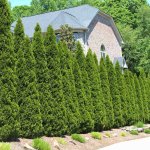
Arborvitae (above) – Another evergreen that grows in a columnar fashion. They will grow to 20 feet or more and a width of 10-15 feet. They need full to part sun to grow well. They can be trimmed to be thinner or allowed to grow wide.

Planting in Berms
One way you can get a natural head start on privacy is to grow your specimens in a raised berm. These can be made using good planting soil (mix in a small amount of native soil) with a height of about 18 inches at the center and tapering down on each side.
This works well because the trees are sitting in an elevated position, providing for excellent drainage and great oxygen circulation in the soil.
It also gives you and 18-inch head start on the height of your visual barrier.
If you choose to create a berm to plant in, you will want to consider installing a drip irrigation to get water to the trees. If you have had a rotor zone in the area, you can simply convert it to drip. Make sure your watering times for a drip zone are enough as it sometimes takes 5-10 minutes for water to reach the end of the drip line.
Another option would be to install bubblers on each individual tree.
Things to do in February . . .
– There is still time to get your pre-emergent applied to your lawn and beds. I do advise using pre-emergent in beds as it does help cut down on the weeds. However, do not do this if you’re relying on seeds to grow flowers. If you do, they will not germinate with pre-emergent down.
– If you have a garden, you will want to get your potatoes planted on Valentines Day.
– Ornamental grasses should be trimmed back this month. Right now they are brown. The brown foliage will not be reclaimed by the plant so its best to go ahead and be rid of it. Doing so allows sunlight to hit the center of the plant, better. Ornamental grass loses its appeal when the center of the plant dies. The trim should be anywhere from 12 inches to 6 inches, depending on the type. Some Pampas grass can be trimmed to a foot or so.
– February is also the month when tons of people hack their Crape Myrtles. I do not endorse this type of maintenance for Crape Myrtles. Instead, they should be trimmed like other trees, removing redundant and erratic growth, keeping the canopy at a good level, etc. I don’t know where the hack method began, but it was a bad idea. Some say it creates fuller growth. While that may or may not be true, the growth that does emerge is weak and young.
– Toward the end of February, you will want to feed your beds with a slow-release granular product. I recommend going with something mild, such as a 10-6-5 formula or similar. This is mild enough to not cause any negative effectives, but strong enough to give your bed plants a nice boost going into spring.
– If you have weeds that begin growing in your lawn this month, you will want to mow them short. Do not allow them to grow for more than 1.5 weeks as thats just enough time for them to seed out. Cutting it before then will prevent the seeds from forming. I recommend this because its almost impossible to kill weeds, chemically, during cold weather months, especially if you have St Augustine turf. Keep the weeds at bay until the heat begins arriving in March.
You’ve bought a beautiful new home. You love the landscape. You love the outdoor living space. It becomes your little paradise. Maybe you build a swimming pool and add a hot tub. Next, you build an outdoor kitchen so you can cook outdoors while enjoying your home life.
Then, the next thing you know a home is built next door. And then another one is built on the other side of you. Suddenly you realize you’ve lost your privacy that you once so enjoyed.
What do you do?
An initial thought might be changing your black iron fencing to a wooden picket fence. Some Homeowners Associations won’t allow this. For some, they may think changing from a six-foot fence to an eight-foot fence will do the trick.
If the homes next door are two-story, raising the fence height won’t help much.
One idea that has proven to be a winner time and again is the living visual barrier. They are both beautiful and effective. Using evergreen selections will assure you of having privacy all year long.
Here are some good choices for visual barriers:
Spartan Junipers (above) – My favorite juniper because of it’s deep, deep green color. It has a columnar growth habit which will top out at around 35-40 feet. They are easy to grow because, let’s face it – it’s a juniper and they love Texas. Once established, they are drought tolerant. Moderately fast growers.
Eastern Red Cedar (above) – Red Cedars are native to our area, so they do very well here. They are efficient at this visual barrier stuff because they can be just as wide as they are tall. They’ll go 30-35 feet in height and are moderately fast growers. They are drought tolerant and very efficient with getting water. You do want to make sure no one in the home is allergic to cedars before planting these.
Savannah Holly (above) – One of my favorite hollies, among many types of hollies! Savannahs grow well here but they should be planted with acidic planting mix. They are fast growers and go to 30+ feet tall and 8-9 feet wide. When planted in a full sun location, their foliage will be dense, dark green and feature attractive red berries.
Madelyn Cypress (above) – The Madelyn is a hybrid Cypress that looks almost identical to the Leyland Cypress. The Madelyns perform well in Texas while the Leyland struggle here. Their graceful look is striking, great curb appeal. They will grow to 12-14 feet and 8 ft wide.
Sweet Viburnum (above) – One of my favorites and often a replacement choice for the Photinia. Sweet Viburnum will create a wide screen with thick foliage when planted in full sun. Their blooming is best known for its sweet aroma, hence the name Sweet Viburnum.
Arborvitae (above) – Another evergreen that grows in a columnar fashion. They will grow to 20 feet or more and a width of 10-15 feet. They need full to part sun to grow well. They can be trimmed to be thinner or allowed to grow wide.
Planting in Berms
One way you can get a natural head start on privacy is to grow your specimens in a raised berm. These can be made using good planting soil (mix in a small amount of native soil) with a height of about 18 inches at the center and tapering down on each side.
This works well because the trees are sitting in an elevated position, providing for excellent drainage and great oxygen circulation in the soil.
It also gives you and 18-inch head start on the height of your visual barrier.
If you choose to create a berm to plant in, you will want to consider installing a drip irrigation to get water to the trees. If you have had a rotor zone in the area, you can simply convert it to drip. Make sure your watering times for a drip zone are enough as it sometimes takes 5-10 minutes for water to reach the end of the drip line.
Another option would be to install bubblers on each individual tree.
Things to do in February . . .
– There is still time to get your pre-emergent applied to your lawn and beds. I do advise using pre-emergent in beds as it does help cut down on the weeds. However, do not do this if you’re relying on seeds to grow flowers. If you do, they will not germinate with pre-emergent down.
– If you have a garden, you will want to get your potatoes planted on Valentines Day.
– Ornamental grasses should be trimmed back this month. Right now they are brown. The brown foliage will not be reclaimed by the plant so its best to go ahead and be rid of it. Doing so allows sunlight to hit the center of the plant, better. Ornamental grass loses its appeal when the center of the plant dies. The trim should be anywhere from 12 inches to 6 inches, depending on the type. Some Pampas grass can be trimmed to a foot or so.
– February is also the month when tons of people hack their Crape Myrtles. I do not endorse this type of maintenance for Crape Myrtles. Instead, they should be trimmed like other trees, removing redundant and erratic growth, keeping the canopy at a good level, etc. I don’t know where the hack method began, but it was a bad idea. Some say it creates fuller growth. While that may or may not be true, the growth that does emerge is weak and young.
– Toward the end of February, you will want to feed your beds with a slow-release granular product. I recommend going with something mild, such as a 10-6-5 formula or similar. This is mild enough to not cause any negative effectives, but strong enough to give your bed plants a nice boost going into spring.
– If you have weeds that begin growing in your lawn this month, you will want to mow them short. Do not allow them to grow for more than 1.5 weeks as thats just enough time for them to seed out. Cutting it before then will prevent the seeds from forming. I recommend this because its almost impossible to kill weeds, chemically, during cold weather months, especially if you have St Augustine turf. Keep the weeds at bay until the heat begins arriving in March.
Last edited by a moderator: