Welcome to the HornSports Forum

By registering with us, you'll be able to discuss, share and private message with other members of our Texas Longhorns message board community.

SignUp Now!

July Landscape Thread - Water savers!

If rain is expected after a somewhat protracted dry spell, would aerating the yard with a spading fork make any difference? I have been told doing so will allow water from expected rains reach deeper in the soil and help the soil retain water. 

Yes, but get ready for some work. Dry clay is tough, tough, tough.

If you get a hard rain with a lot of water associated, those aerated holes will fill right back up. It's just the nature of our clay.

 
Just a heads up.

With the recent rains and cooler temps, you can expect a mild to significant increase in insect activity and population.

I'm seeing it in the field. The incoming calls are increasing. The necessary elements are in place for this to happen.

Keep an eye on your shrubs, vines, succulent flowers and even Crape Myrtles and other ornamental trees. Watch for bagworms and cutworms in larger trees such as Pecans or even Bald Cypress. Watch for chinch bugs in the lawn - their damage has been discussed in this thread.

There are plenty of remedies readily available to address these critters, but often times we notice the damage too late. Catch it early, identify the insect that's being destructive, then identify the product you're going to need to kill it. That is often as easy as reading a label at Lowes. Of course, you can always email me with your pictures and I'll gladly help you out.

One critter that has the potential to be extremely harmful are grasshoppers. I've already responded to two calls on them in Tarrant County. They are growing in number and are beginning to leave behind damage. The troubling thing is - there is no real chemical solution and here's why:

       - While we can spray foliage which would kill a grasshopper, each grasshopper will consume part of the plant before it dies. In numbers, this makes the chemical application effective at killing, but not effective at protecting the foliage. So I recommend mesh netting for shrubs and trees and other plants that you see being attacked by grasshoppers. Shoot me an email if you're not sure where to get them.

greenthumbtx@verizon.net

While it has been cool and wet, do not worry about any development of fungus in the lawns. It's going to be 100 next week so that takes care of whatever fungus could have started developing.

 
Last edited by a moderator:
Hi Sirhornsalot

I have a large fig tree that is about 4 years old.  I do not know the fig type (very large brown fig but not the most tasty).  It's growth has been extra ordinarily fast.  My problem is I have gotten figs only 1 year.  Due to its excessive growth I pruned it back before last years growth (it's now over 20ft. tall).  Last year, what few figs it grew did not ripen.  Again this year the figs are not ripening (I did not pruning this last winter).  The branches appear to need pruning again- they are long & without much branching.

Do you have any ideas what I need to do to get figs? 

 
Hi Sirhornsalot

I have a large fig tree that is about 4 years old.  I do not know the fig type (very large brown fig but not the most tasty).  It's growth has been extra ordinarily fast.  My problem is I have gotten figs only 1 year.  Due to its excessive growth I pruned it back before last years growth (it's now over 20ft. tall).  Last year, what few figs it grew did not ripen.  Again this year the figs are not ripening (I did not pruning this last winter).  The branches appear to need pruning again- they are long & without much branching.

Do you have any ideas what I need to do to get figs? 

Have you ever fertilized this fig?

I would suggest fertilizing with a granular 10-5-5 or closest (see my note, below) and also some dissolved in water epsom salts with a couple of teaspoons of Superthrive added to the mix. Pour around the base. Do this twice a month during the growing season but start in early February.

Scatter the granular over the root ball area. It's best to do this right before a nice rain and when temps are not in the upper 90s/100s. Doing this in hot weather could result in some leaf burn.

 
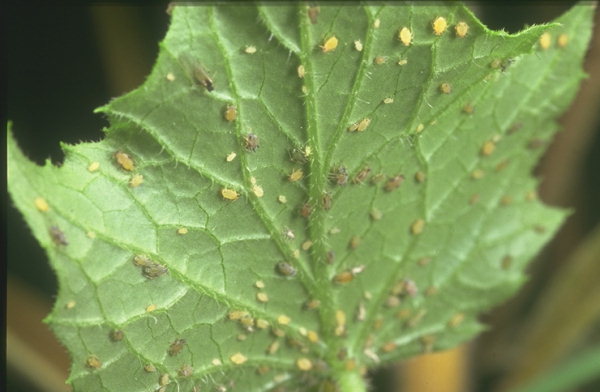
I applied Sevin on my cucumber plants.  I think they've multiplied.  Why are alphids harmful?  

 
I applied Sevin on my cucumber plants.  I think they've multiplied.  Why are alphids harmful?  

They suck the moisture from leaves, hurting the plant. They excrete a sugary substance which will draw in ants and other insects. They're a mess.

I used the Sevin on my squash and killed the aphids but the plant was too far gone to do anything at that point.

 
Cinch bug coffee can test...do I just leave it in the yard and the bugs will be found in the soapy water if they are in my yard? Thanks Mark.

 
Are aphids orange and black? Had this type on my green pepper plants last year. Funny, the pest control dope at my door couldn't tell me what these were! No sale for that guy. I squashed them daily vs treating, inefficiency and lack of effort to find a solution on my part.

 
There are many types of aphids and they look quite different

aphids-tall-goldenrod-b.jpg


aphids.jpg


Aphidsnew.jpg


Cinch bug coffee can test...do I just leave it in the yard and the bugs will be found in the soapy water if they are in my yard? Thanks Mark.

No, it's an immediate result. You would put the can in the suspected area. Push it into the ground slightly, then pour the soapy water in. Any chinch bugs in the turf will immediately float to the top. You will know in minutes as they all finally float up. At that point, test is over.

Try not to let the soapy water get too foamy.

 
Looks like my cucumber plants failed due to aphids.  I'm pulling both my cucumber and cantaloupe plants tomorrow.  Any suggestions on what to plant next?  Should I just stick to an herb garden?  My basil plants are very successful.  No aphids on them.  

 
They suck the moisture from leaves, hurting the plant. They excrete a sugary substance which will draw in ants and other insects. They're a mess.

I used the Sevin on my squash and killed the aphids but the plant was too far gone to do anything at that point.
Ahh!  No wonder I see ants all over my garden!

 
Looks like my cucumber plants failed due to aphids.  I'm pulling both my cucumber and cantaloupe plants tomorrow.  Any suggestions on what to plant next?  Should I just stick to an herb garden?  My basil plants are very successful.  No aphids on them.  
There may still be some tomato plants available for fall harvest!!

You may also try some bell peppers?

 
No, it's an immediate result. You would put the can in the suspected area. Push it into the ground slightly, then pour the soapy water in. Any chinch bugs in the turf will immediately float to the top. You will know in minutes as they all finally float up. At that point, test is over.

Try not to let the soapy water get too foamy.
So I am now realizing the ends must be removed from both sides of the coffee can for this venture. Thanks for the how to, I will Mcgyver a can and put the yard to the test. Your expertise is much appreciated!

 
Ok, no takers in the Austin area for the 30 gallon sized Natchez Crape Myrtle (white blooms). I originally offered this tree for FREE to the first Austin referral customer for lawn chemical maintenance services or other landscape project. 

NOW, that offer is being made to the Dallas-Fort Worth area Longhorns who provide a new customer referral for lawn maintenance, chemical lawn maintenance or other landscape project. Retail value on this tree is $210.00.

Additionally, for any Longhorn who gives me TWO new customer referrals - I'll give you a 30 gallon sized Pindo Palm - FREE. Retail value for this tree is $390.00

I would post pictures of them both but my image shack membership somehow expired in three weeks time. I don't know where I can upload to. Both trees are sitting in my back yard getting pampered right now.

 
SHA, the cinch bug can test proved negative in my front yard. I am now convinced that excessive sun hitting parts of my yard is the culprit for my dead St Augustine patches. Same spots died a few years ago, I resodded the spots only to have them keel over again. The sun seems to reflect off the windows on the front of the house and possibly burn out the spots (house faces East and these windows get a lot of midday to early afternoon sun). Backyard is green and beautiful, is mostly fully shaded by a cluster of oaks fortunately. Solar screens? Solar film (does this exist?)? Would prefer not to resod until spring due to watering restrictions and Sahara heat this summer. Any thoughts? Will most likely consult Greenthumb in the spring regarding sod project. Do you all also do any masonry type landscaping projects or lighting?

 
SHA, the cinch bug can test proved negative in my front yard. I am now convinced that excessive sun hitting parts of my yard is the culprit for my dead St Augustine patches. Same spots died a few years ago, I resodded the spots only to have them keel over again. The sun seems to reflect off the windows on the front of the house and possibly burn out the spots (house faces East and these windows get a lot of midday to early afternoon sun). Backyard is green and beautiful, is mostly fully shaded by a cluster of oaks fortunately. Solar screens? Solar film (does this exist?)? Would prefer not to resod until spring due to watering restrictions and Sahara heat this summer. Any thoughts? Will most likely consult Greenthumb in the spring regarding sod project. Do you all also do any masonry type landscaping projects or lighting?

Mikev73,

I think Hydretain would be helpful for your front yard. I think your real issue could be sprinkler coverage (I would check this) or maybe even that the zones in the front need more time than you've allowed in the past.

With an east-facing front, your window reflection is probably not what you're having trouble with. If it is, it would be the first I've heard of.

When you're ready to sod, we can give the new sod some added durability by adding some expanded shale to the subsurface. This will keep your soil from compacting, stores water in the root zone, and lasts for years. It's also relatively cheap.

Check your sprinkler coverage, first. Then if that looks good, try upping your time in the zone where you're having trouble.

St Augustine must be kept HIGH during the hot summer months. If you're cutting your lawn at less than 3 inches, then that could contribute to the St Augustine recession. When sunlight is able to bake the soil surface, St Augustine will suffer. So mow at 3-3.5" during July-August, lower the blade to 2.5 during the fall and early spring.

And yes, we do stonework, concrete, etc., and landscape lighting.

 
 
Last edited by a moderator:
I had the last cedar in my yard cut down today.  Told the guys it was fine just to cut it off ay ground level.  My wife heard the cedar roots will keep sucking water if you don't pour something on the base of the tree.

Do you have any clue if this is a fact?  I'm thinking gasoline or salt water.

 
Mikev73,

I think Hydretain would be helpful for your front yard. I think your real issue could be sprinkler coverage (I would check this) or maybe even that the zones in the front need more time than you've allowed in the past.

With an east-facing front, your window reflection is probably not what you're having trouble with. If it is, it would be the first I've heard of.

When you're ready to sod, we can give the new sod some added durability by adding some expanded shale to the subsurface. This will keep your soil from compacting, stores water in the root zone, and lasts for years. It's also relatively cheap.

Check your sprinkler coverage, first. Then if that looks good, try upping your time in the zone where you're having trouble.

St Augustine must be kept HIGH during the hot summer months. If you're cutting your lawn at less than 3 inches, then that could contribute to the St Augustine recession. When sunlight is able to bake the soil surface, St Augustine will suffer. So mow at 3-3.5" during July-August, lower the blade to 2.5 during the fall and early spring.

And yes, we do stonework, concrete, etc., and landscape lighting.
Mark, thanks for the info.  In retrospect, the turf started to fade prior to the heat of summer.  Also, I don't have an inground sprinkler system, just the dude moving a hose around the yard program.  My front yard is not sizable, and the areas in question are in prime locations to receive plenty of water with my sprinkler placement.  Maybe need to test more areas for cinch bugs?  I'm guessing I need to check more areas where the grass is actually doing well to see if the bugs surface in the can?  I am realizing I really only ran the test on/near the dead areas, which now seems inadequate.  I will check again and then irritate you further with more amateur lawn care maneuvers on my part!  As my trees get larger in the front yard, they will provide more shade to these areas in theory and decrease the punishing sun I hope.  Either way, thanks for being my sounding board.  I will investigate further and attempt to solve this mystery. 

 
Back
Top Bottom