See they have placed Sam in concussion protocol and I am guessing that he might not play this Saturday. Is this his first or second one of the year...as I fear he might end up like David Ash. If he is out does that change our prospects with Baylor?


Welcome to the HornSports Forum
By registering with us, you'll be able to discuss, share and private message with other members of our Texas Longhorns message board community.
SignUp Now!You are using an out of date browser. It may not display this or other websites correctly.
You should upgrade or use an alternative browser.
You should upgrade or use an alternative browser.
Sam Ellinger is in Concussion Protocol
- Thread starter mctmatt
- Start date

okiehorn
Well-known member
- Joined
- Sep 18, 2016
- Messages
- 3,210
Yea all this was said in Herman’s presser. They’ll no if Shane will be QB by Wednesday or Thursday and Heard will be getting reps also. Said it does open up the play book a little more and the pass game which may help, if he has time to Throw it anywaySee they have placed Sam in concussion protocol and I am guessing that he might not play this Saturday. Is this his first or second one of the year...as I fear he might end up like David Ash. If he is out does that change our prospects with Baylor?


RickyFlair
Well-known member
- Joined
- Jan 13, 2016
- Messages
- 1,044
Officially it is concussion number 1 for him.I would too hate it for Sam, but isn't this concussion number 2 for him this season or am I just making crap up in my head? Really , I thought he had one before this one.

DBut82
Rookie
- Joined
- Nov 15, 2013
- Messages
- 1,827
And I think we have to at least double that. Ya know, sorta like you have to with the answer a girl gives after you ask her how many guys she's been with. I know he was cleared to against HoeU but no one can convince me that he didn't have a concussion that game. His head didn't bounce off the turf against OSU nearly as viciously as it did against the Sooners and he's still suffering symptoms. Forget football for a moment tho. I'm praying this kids doesn't have lingering effects...Officially it is concussion number 1 for him.
He was cleared by the medical staff to go back against OU. Like TH said in his presser, concussion protocol is not a coaches decision. I think it is fair to assume that we have one of the best training staffs in the nation, so I highly doubt that he was concussed in that game, plus he was also not in protocol during the week.And I think we have to at least double that. Ya know, sorta like you have to with the answer a girl gives after you ask her how many guys she's been with. I know he was cleared to against HoeU but no one can convince me that he didn't have a concussion that game. His head didn't bounce off the turf against OSU nearly as viciously as it did against the Sooners and he's still suffering symptoms. Forget football for a moment tho. I'm praying this kids doesn't have lingering effects...
We don't exactly know where he sustained that possible concussion against OSU, if it was indeed that hit in overtime that I posted in the other thread. But he went back up immediately and showed no sign of a possible concussion. Per TH, the symptoms started to occur on Saturday evening / Sunday.
I think the training staff's primary concern is players safety and I firmly believe they did nothing wrong. Otherwise it would be contradictory that he was now placed in concussion protocol.
Captain Hookem
Rookie
- Joined
- Nov 26, 2013
- Messages
- 356
Let me preface this by saying I don't think the staff did anything wrong either. He was cleared against OU and said he was fine. What happened against OSU was a bang-bang play in overtime without time to evaluate. And I'm sure the staff's primary concern was safety also when Ash was here.
But the pattern is the same... an initial hard hit for the first concussion, with a likely 2nd concussion on a smaller hit. Ash had symptoms also not show up until the next morning.
It's the ease of the 2nd concussion that should worry everyone because of how long this apparently takes to heal, and by that I mean giving the brain enough time so that a subsequent concussion isn't a much higher risk. For Ash that took months, possibly years, before he was finally cleared by doctors to play full contact again.
I'm not saying that's where Ehlinger is right now. But as I mentioned in the other thread if he goes out and gets a 3rd concussion we're having a totally different conversation about this. I have no idea how doctors can determine this, but unless they're 100% sure he's not still susceptible to more concussions I would effectively put him on IR for the rest of the season. We're in future mode at this point anyway if we're being totally honest.
But the pattern is the same... an initial hard hit for the first concussion, with a likely 2nd concussion on a smaller hit. Ash had symptoms also not show up until the next morning.
It's the ease of the 2nd concussion that should worry everyone because of how long this apparently takes to heal, and by that I mean giving the brain enough time so that a subsequent concussion isn't a much higher risk. For Ash that took months, possibly years, before he was finally cleared by doctors to play full contact again.
I'm not saying that's where Ehlinger is right now. But as I mentioned in the other thread if he goes out and gets a 3rd concussion we're having a totally different conversation about this. I have no idea how doctors can determine this, but unless they're 100% sure he's not still susceptible to more concussions I would effectively put him on IR for the rest of the season. We're in future mode at this point anyway if we're being totally honest.
DBut82
Rookie
- Joined
- Nov 15, 2013
- Messages
- 1,827
As much as would hate it for Sam, I have to totally agree with this post. It just sucks for the kid.Let me preface this by saying I don't think the staff did anything wrong either. He was cleared against OU and said he was fine. What happened against OSU was a bang-bang play in overtime without time to evaluate. And I'm sure the staff's primary concern was safety also when Ash was here.
But the pattern is the same... an initial hard hit for the first concussion, with a likely 2nd concussion on a smaller hit. Ash had symptoms also not show up until the next morning.
It's the ease of the 2nd concussion that should worry everyone because of how long this apparently takes to heal, and by that I mean giving the brain enough time so that a subsequent concussion isn't a much higher risk. For Ash that took months, possibly years, before he was finally cleared by doctors to play full contact again.
I'm not saying that's where Ehlinger is right now. But as I mentioned in the other thread if he goes out and gets a 3rd concussion we're having a totally different conversation about this. I have no idea how doctors can determine this, but unless they're 100% sure he's not still susceptible to more concussions I would effectively put him on IR for the rest of the season. We're in future mode at this point anyway if we're being totally honest.
The Bry-Man81
New member
- Joined
- Jan 23, 2015
- Messages
- 846
The problem is that sometimes, symptoms do not always show up right away and they're not always the same across each person. One person might have mild amnesia and confusion, balance issues, "got his bell rung" type symptoms where another might have headaches and problems focusing, etc. It's very possible that during OU, he wasn't having symptoms immediately after the hit and was cleared to go back in, and then started to develop symptoms later during the week. If they're mild symptoms, maybe he doesn't think much of it, doesn't report them, or maybe he tries to tough it out because that's the kind of player that Sam seems to be. Maybe this concussion is lingering from OU, maybe it got exacerbated during OSU, or maybe he never had a concussion and this is in fact truly entirely from the OSU game. I'm completely speculating and it's impossible to know. That being said, it's not impossible that he suffered a concussion during OU and was symptom free in the immediate aftermath, hence being cleared to go into the game.He was cleared by the medical staff to go back against OU. Like TH said in his presser, concussion protocol is not a coaches decision. I think it is fair to assume that we have one of the best training staffs in the nation, so I highly doubt that he was concussed in that game, plus he was also not in protocol during the week.
.
.
.
I think the training staff's primary concern is players safety and I firmly believe they did nothing wrong. Otherwise it would be contradictory that he was now placed in concussion protocol.
Last edited by a moderator:
The Bry-Man81
New member
- Joined
- Jan 23, 2015
- Messages
- 846
It's impossible to make the determination and to be 100% sure that he won't be susceptible to more concussions. The people most susceptible to getting concussions are those that have had one before (then 2, then 3 and so on), so I think technically, he will always be at a theoretical higher risk. The only thing a doctor can do is monitor symptoms if they are present and counsel him and his family appropriately.Let me preface this by saying I don't think the staff did anything wrong either. He was cleared against OU and said he was fine. What happened against OSU was a bang-bang play in overtime without time to evaluate. And I'm sure the staff's primary concern was safety also when Ash was here.
But the pattern is the same... an initial hard hit for the first concussion, with a likely 2nd concussion on a smaller hit. Ash had symptoms also not show up until the next morning.
It's the ease of the 2nd concussion that should worry everyone because of how long this apparently takes to heal, and by that I mean giving the brain enough time so that a subsequent concussion isn't a much higher risk. For Ash that took months, possibly years, before he was finally cleared by doctors to play full contact again.
I'm not saying that's where Ehlinger is right now. But as I mentioned in the other thread if he goes out and gets a 3rd concussion we're having a totally different conversation about this. I have no idea how doctors can determine this, but unless they're 100% sure he's not still susceptible to more concussions I would effectively put him on IR for the rest of the season. We're in future mode at this point anyway if we're being totally honest.
If he's not exhibiting any symptoms, then there's no reason he can't play if he wants to, but it's up to the doctor to clearly explain the risks and potential of future concussions so that he and his family can make an informed decision. The problem is that concussions don't act the same for everyone; some people have a second concussion a year removed from the first and experience the effects of that for a long time (i.e. Ash), some people have their 2nd concussion in 6 months and get over it fine. Some people get a first concussion and symptoms last a few days, some people it lasts a month. And it has no correlation with how they were injured or the perceived intensity of the impact. Some people get punched or kicked in the head and don't get a repeat concussion, some people get symptoms if they try to head a soccer ball. So it is very difficult to say for certain or to predict a quantifiable risk. Naturally this changes if you've had 3, 4, 5 concussions etc... But at 1 or 2, you leave it up to the player and their family (as long as they're symptom free) and make sure that they know to report any symptoms as soon as they happen.

HORNfromETX
Well-known member
- Joined
- Aug 9, 2016
- Messages
- 2,797
Per 247 Shane is starting Saturday
Captain Hookem
Rookie
- Joined
- Nov 26, 2013
- Messages
- 356
Interesting info...It's impossible to make the determination and to be 100% sure that he won't be susceptible to more concussions. The people most susceptible to getting concussions are those that have had one before (then 2, then 3 and so on), so I think technically, he will always be at a theoretical higher risk. The only thing a doctor can do is monitor symptoms if they are present and counsel him and his family appropriately.
If he's not exhibiting any symptoms, then there's no reason he can't play if he wants to, but it's up to the doctor to clearly explain the risks and potential of future concussions so that he and his family can make an informed decision. The problem is that concussions don't act the same for everyone; some people have a second concussion a year removed from the first and experience the effects of that for a long time (i.e. Ash), some people have their 2nd concussion in 6 months and get over it fine. Some people get a first concussion and symptoms last a few days, some people it lasts a month. And it has no correlation with how they were injured or the perceived intensity of the impact. Some people get punched or kicked in the head and don't get a repeat concussion, some people get symptoms if they try to head a soccer ball. So it is very difficult to say for certain or to predict a quantifiable risk. Naturally this changes if you've had 3, 4, 5 concussions etc... But at 1 or 2, you leave it up to the player and their family (as long as they're symptom free) and make sure that they know to report any symptoms as soon as they happen.
I would've assumed that simply time and rest would return a person to a state they were pre-concussion. However it sounds like once the pump is primed the risk may always higher. Also didn't know the atypical nature of concussions over time as compared to other injuries. Fortunately don't have personal experience with concussions, but having dealt with chronic migraines for a long time know the brain can be really weird.
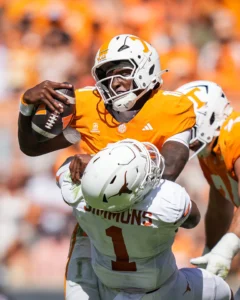
The problem for Sam is that he will have teams now trying to bang his head in the ground. The OSU hit looks like the defender was driving Sam's shoulder pads to the ground, preventing him from bending upwards to minimize impact. Not really a dirty tackle, but if he had a bum shoulder they'd be tackling him sideways to drive his shoulder to the ground. That's just a part of football. I don't know if there are techniques Sam can use to help avoid impact that way.
One thing I started paying attention to after Romo started getting injured was how Tom Brady folds up when tackled. Brady kind of crumples forward and turtles right before he's tackled, and you hardly ever see him take a hard hit. Romo started doing this later in his career, but it was too late by that point.
QBs are just more vulnerable in certain situations. I don't know if the fact it happened two weeks in a row, in almost identical fashion, is just extremely bad luck or a situation that Sam could potentially avoid.

DMAC
Well-known member
- Joined
- Nov 9, 2014
- Messages
- 5,417
Just a thought here with absolutely no knowledge about concussions. Ever notice how tight Sams helmet looks on him? To me it appears his face is bulging out when wearing his helmet. I know the kid is "thick" and stocky, If I remember correctly Ash appeared the same way to me.
RickyFlair
Well-known member
- Joined
- Jan 13, 2016
- Messages
- 1,044
When you said that I immediately thought of Jim Plunkett because his head always looked like it was poured in to his helmet.Just a thought here with absolutely no knowledge about concussions. Ever notice how tight Sams helmet looks on him? To me it appears his face is bulging out when wearing his helmet. I know the kid is "thick" and stocky, If I remember correctly Ash appeared the same way to me.

I didn't realize he is dealing with all kinds of health issues related to multiple head injuries. I didn't even remember him getting hurt much. I just remember thinking his head looked too big for his helmet.
You may be on to something.
I think it is like a car seatbelt the tighter the better in terms of protection ... this is my guess.Just a thought here with absolutely no knowledge about concussions. Ever notice how tight Sams helmet looks on him? To me it appears his face is bulging out when wearing his helmet. I know the kid is "thick" and stocky, If I remember correctly Ash appeared the same way to me.
RickyFlair
Well-known member
- Joined
- Jan 13, 2016
- Messages
- 1,044
I know the helmet itself (tight or loose) isn't a factor in concussions. A helmet doesn't actually have any benefit at all in regards to concussions.I think it is like a car seatbelt the tighter the better in terms of protection ... this is my guess.
I was thinking the shape of a persons head might make them more or less susceptible to concussions. It sounds kind of ridiculous but if the area inside the skull allows more movement for the brain it could "in theory" make a difference.
After DMAC made the comment I looked at pictures of players who struggled with concussions. Jim Plunkett and Mike Webster both look like their faces are closer to their facemask than other players. I suspect that could mean the distance from the back of the skull to the front might be longer than other people. That could also indicate, unless they have abnormally large heads, that the distance from the right and left sides of the skull could be shorter than average.


About Us
