

Sirhornsalot
**The Official Horn Sports Landscaper and Landscap
- Joined
- Nov 6, 2013
- Messages
- 33,310
August heat is upon us, looks like summer finally arrived with all this 100 degree heat we’re having. That said, fall will be here before you know it so below is a list of things to do this month.
With water restrictions, heat like this can be brutal. Now is a good time to check and make sure your sprinkler system is operating properly.
- On Labor Day, change your sprinkler settings from evening waterings to morning waterings. This is especially important if you have St Augustine turf. This will help you avoid having a fungus develop in your lawn which normally happens in September-October.
- Your second round of pre-emergent should go down this month. You can put this down anytime between now and end of month. It will not harm your lawn in this heat.
- Your third round of fertilizer should be applied at the end of the month. Use a lower number on the nitrogen for this application. For St Augustine/Zoysia, you’re looking for about a 15-17. For Bermuda, no higher than 25. Apply your fertilizer at slightly lower than the recommended rate. So if your spreader setting is supposed to be 4, go with 3.5 instead. Nitrogen helps grass grow, but it also helps fungus grow. So we want to be careful not to spread too much.
- Chinch Bugs are already active, but normally are in full force by third week of August. You will recognize their presence by turf that looks like it’s burning up in spotty, random fashion and will likely be near a sidewalk or street curb/concrete source. Products like Mallet or Bifedrin (liquids) will knock out Chinch bugs as will granulars like arena or dylox.
- St Augustine/Zoysia lawns are often helped with an application of granular fungicide this month. This acts as some insurance against the possible development of fungus which becomes a higher risk during September/October.
- Remember to not only change your sprinkler settings from evening to morning on Labor Day, but also reduce your watering by a day when temperatures drop back down into the 90s on a consistent basis. August-September is a transition period where days become shorter, nights become cooler and longer and evaporation slows down. These factors combined are ideal for fungus development.
Below, lawn fungus

- For you Bermuda lawn owners who enjoy a nice thick Winter Rye lawn in the winter, late September will be the time when you want to overseed with the Winter Rye. I mention this now because Winter Rye seed is one of those products where the early bird gets the worm. If you overseed in October, you’re probably buying a lower grade seed mix.
- If you think you may need to have your trees trimmed, between now and November is the ideal time. You want to get this done before your trees drop their leaves. If we have a hard winter, you’ll be glad you had this done.
- Do not be afraid to skip a week of mowing during this high heat period. I keep my St Augustine at about 3.25 inches. But when it’s 100 outside, I will often let it go two weeks between mows just to keep it healthier. Each time you mow, your lawn may look nice but it’s also at risk during 100 degree temps. If you have the luxury of watering when you want to - do so right after mowing. It speeds the healing process as mowing grass is actually inflicting a wound. Water helps it recover quickly.
Here’s a couple of questions I’ve fielded in the last week or so:
Question - I have a stump located next to my house that I need to have grinded. How do I go about this?
Answer - You don’t. A stump grinder is a very large machine and it requires a certain amount of space to operate in. A stump against the house doesn’t allow enough space without some type of damage occurring. However, what you can do is take a drill and drill several holes into the stump. Then, pour Epsom Salts into the holes and leave it there. The Epsom Salts will suck out all of the moisture in the stump so that the wood goes dry and rots. Once rotten, you can knock it out with a hatchet or even a hammer.
Question - Grasshoppers have invaded my back yard landscape. They’re eating my Palms, which I have 7 of them. What can I do?
Answer - Grasshoppers can literally destroy a beautiful landscape in a very short amount of time. I recommend that you install netting over the Palms and any other plant that they’re feeding on. You’ll want to get the 1/4†size netting or smaller so the littler critters can’t sneak their way through the holes. Additionally, apply a product called “No-Lo Bait†to areas AWAY from the Palms. This product will attract the grasshoppers away from the Palms (because you put it away from them) and once they ingest it, they will not produce viable young and their appetite is decreased dramatically. Fort Worth and it’s northern suburbs have been hit hard this year for some reason.
Question - I have a Maple that I planted two years ago. Each of those two years it has had its leaves turn brown and drop before the fall season began. Why does this happen and what do I need to do to stop it? I want my fall color!
Below, an example of the Maple leaf condition as mentioned in the above question.
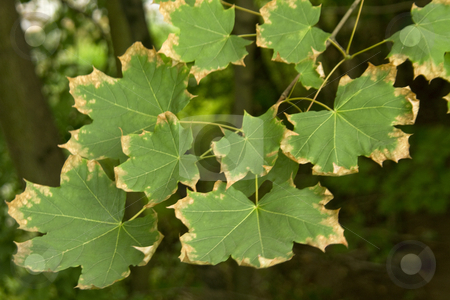
Answer - The past two years we’ve had drought conditions with high heat. The lack of moisture or reduced moisture combined with high heat will cause a Maple (any type of Maple) to instinctively give up its leaves, starting with the outer layer. This is a self-defense mechanism and is perfectly normal. However, it also tells you the tree has been stressed. This year, we’ve had an increase in rainfall and not so many days in the 100s. So Maples should be doing better everywhere unless they’re a first or second year specimen. By year three, this problem usually goes away as they’re more established by then. Japanese Maples will behave the same way. To increase the likelihood of good fall color, supplement your Maple’s watering by using either a Gator bag or by “dripping†the root ball using a water hose for a couple hours. Don’t overdo it as you don’t want to cause a root rot. The dripping can be done once a week and provide effective results in October/November.
I'll take any questions you might have, no matter how trivial you may think they are. Someone else may have the same issue as you and gain benefit from you asking!
Also, would love to hear about the results of everyone's home gardens so far. My fall tomatoes are now about two feet high, just now seeing some blooms but the high heat has kept them from really taking off. My bell peppers are doing very well. One plant right now has 9 peppers on it, all the same size!
How's your stuff doing? Post pictures if you have them!
With water restrictions, heat like this can be brutal. Now is a good time to check and make sure your sprinkler system is operating properly.
- On Labor Day, change your sprinkler settings from evening waterings to morning waterings. This is especially important if you have St Augustine turf. This will help you avoid having a fungus develop in your lawn which normally happens in September-October.
- Your second round of pre-emergent should go down this month. You can put this down anytime between now and end of month. It will not harm your lawn in this heat.
- Your third round of fertilizer should be applied at the end of the month. Use a lower number on the nitrogen for this application. For St Augustine/Zoysia, you’re looking for about a 15-17. For Bermuda, no higher than 25. Apply your fertilizer at slightly lower than the recommended rate. So if your spreader setting is supposed to be 4, go with 3.5 instead. Nitrogen helps grass grow, but it also helps fungus grow. So we want to be careful not to spread too much.
- Chinch Bugs are already active, but normally are in full force by third week of August. You will recognize their presence by turf that looks like it’s burning up in spotty, random fashion and will likely be near a sidewalk or street curb/concrete source. Products like Mallet or Bifedrin (liquids) will knock out Chinch bugs as will granulars like arena or dylox.
- St Augustine/Zoysia lawns are often helped with an application of granular fungicide this month. This acts as some insurance against the possible development of fungus which becomes a higher risk during September/October.
- Remember to not only change your sprinkler settings from evening to morning on Labor Day, but also reduce your watering by a day when temperatures drop back down into the 90s on a consistent basis. August-September is a transition period where days become shorter, nights become cooler and longer and evaporation slows down. These factors combined are ideal for fungus development.
Below, lawn fungus
- For you Bermuda lawn owners who enjoy a nice thick Winter Rye lawn in the winter, late September will be the time when you want to overseed with the Winter Rye. I mention this now because Winter Rye seed is one of those products where the early bird gets the worm. If you overseed in October, you’re probably buying a lower grade seed mix.
- If you think you may need to have your trees trimmed, between now and November is the ideal time. You want to get this done before your trees drop their leaves. If we have a hard winter, you’ll be glad you had this done.
- Do not be afraid to skip a week of mowing during this high heat period. I keep my St Augustine at about 3.25 inches. But when it’s 100 outside, I will often let it go two weeks between mows just to keep it healthier. Each time you mow, your lawn may look nice but it’s also at risk during 100 degree temps. If you have the luxury of watering when you want to - do so right after mowing. It speeds the healing process as mowing grass is actually inflicting a wound. Water helps it recover quickly.
Here’s a couple of questions I’ve fielded in the last week or so:
Question - I have a stump located next to my house that I need to have grinded. How do I go about this?
Answer - You don’t. A stump grinder is a very large machine and it requires a certain amount of space to operate in. A stump against the house doesn’t allow enough space without some type of damage occurring. However, what you can do is take a drill and drill several holes into the stump. Then, pour Epsom Salts into the holes and leave it there. The Epsom Salts will suck out all of the moisture in the stump so that the wood goes dry and rots. Once rotten, you can knock it out with a hatchet or even a hammer.
Question - Grasshoppers have invaded my back yard landscape. They’re eating my Palms, which I have 7 of them. What can I do?
Answer - Grasshoppers can literally destroy a beautiful landscape in a very short amount of time. I recommend that you install netting over the Palms and any other plant that they’re feeding on. You’ll want to get the 1/4†size netting or smaller so the littler critters can’t sneak their way through the holes. Additionally, apply a product called “No-Lo Bait†to areas AWAY from the Palms. This product will attract the grasshoppers away from the Palms (because you put it away from them) and once they ingest it, they will not produce viable young and their appetite is decreased dramatically. Fort Worth and it’s northern suburbs have been hit hard this year for some reason.
Question - I have a Maple that I planted two years ago. Each of those two years it has had its leaves turn brown and drop before the fall season began. Why does this happen and what do I need to do to stop it? I want my fall color!
Below, an example of the Maple leaf condition as mentioned in the above question.
Answer - The past two years we’ve had drought conditions with high heat. The lack of moisture or reduced moisture combined with high heat will cause a Maple (any type of Maple) to instinctively give up its leaves, starting with the outer layer. This is a self-defense mechanism and is perfectly normal. However, it also tells you the tree has been stressed. This year, we’ve had an increase in rainfall and not so many days in the 100s. So Maples should be doing better everywhere unless they’re a first or second year specimen. By year three, this problem usually goes away as they’re more established by then. Japanese Maples will behave the same way. To increase the likelihood of good fall color, supplement your Maple’s watering by using either a Gator bag or by “dripping†the root ball using a water hose for a couple hours. Don’t overdo it as you don’t want to cause a root rot. The dripping can be done once a week and provide effective results in October/November.
I'll take any questions you might have, no matter how trivial you may think they are. Someone else may have the same issue as you and gain benefit from you asking!
Also, would love to hear about the results of everyone's home gardens so far. My fall tomatoes are now about two feet high, just now seeing some blooms but the high heat has kept them from really taking off. My bell peppers are doing very well. One plant right now has 9 peppers on it, all the same size!
How's your stuff doing? Post pictures if you have them!
Last edited by a moderator: