

Sirhornsalot
**The Official Horn Sports Landscaper and Landscap
- Joined
- Nov 6, 2013
- Messages
- 34,881
So what to do now? March is here, but it seems winter is still hanging around. Most folks I know are chomping at the bit to get started with their spring gardening. I've received PMs and emails asking when to do their first fertilization treatment.
Patience.
Most turf is still dormant. Turf in San Antonio and Houston might be turning green right now, especially St Augustine. But it's not actively growing. The nights are still too cold for that to happen. There's no point in putting down fertilizer if it's not going to cause growth. Plus, you put your turf at risk because conditions are cool and damp, ripe for fungus. The nitrogen in fertilizer enhances the growth of fungus.
April 1 is a good date for DFW folks. Last week of March for Austin, San Antonio and Houston folks.
Q&A WITH HORNSPORTS MEMBERS
1. Looking for suggestions for colorful perennials to put in two large flower beds in the Austin area. The beds get very little sunlight through out the course of the day. Your thoughts?
Heavy shade? Try the Society Garlic, shown in my feature plants below. They enjoy the shade, are evergreen in Austin, SA and Houston, and the deer leave them alone! Beyond that, shade poses some challenges for those trying to achieve color. You can turn to Variegated Pink Ginger, Turk's Cap, Dianella (variegated flax lilly), Oxalis (crimson clover) and for seasonal flowers, go with New Guinea Impatiens.
Oxalis

2. When should I put on pre-emergent fertilizer on my lawn?
A - Pre emergent and fertilizer are two different products entirely and should not be applied at the same time. It won't hurt to apply them together, but because of timing, they are not. Pre emergent should have been applied back in mid-February, but it's always better to be late than to not apply at all. Fertilizer should go down around first of April and then again in June and again in September. Pre emergent goes down in February, August and November.
3. I forgot to bring in my Hawaiian Ti plants last night and there was ice all over the leaves the next morning. Will the leaves die now? This will mortally P... me off as we grew these plants from sticks we bought on our last Hawaiian trip.
Mahalo is a no no.
You'll likely lose those leaves that were "burnt" by the ice. As long as the stalk and roots were not damaged, you should see a fairly quick grow back once temperatures get a little higher than they are now. If the ice was only on there for a day, then damage will be minimal. If it was there multiple days, then it could drop them all.
4. What's better: standard chemical fertilizer like Scott's etc or spreading manure over the yard? Or maybe another way to express the question; is the additional work to top dress with manure worth the time and effort?
I don't recommend topdressing with manure. It will burn the lawn up, too much "fresh" nitrogen. I do recommend topdressing with a COMPOSTED manure, where the stuff is broken down and the nitrogen content is way down. You're looking to replenish trace minerals and nutrients with compost, not really fertilize. Chemical fertilizer products like Scotts are time-released by design, therefore they will not burn the lawn unless you just starve it of water after applying. If you're looking for an organic option, there's corn gluten which has about a 9% nitrogen content.
5. What in your opinion is the biggest waists of money at the yard store and or the biggest mistakes you see yard owners do over an over again.
If this is a regional question Im in Austin.
There are so many . . . A lot of mistakes start right there in the Garden Dept of Lowes or Home Depot. The man/woman helping you and giving you advice was working the plumbing dept. the week before. I also would not buy a plant or tree from either place. They are always smaller than everyone else's plants because they will take a 1 gallon plant, put it in a 3 gallon container and sell it as a 3 gallon plant instead of a 1 gallon plant. Doing this, they can afford to give you a money-back warranty as most folks just won't go back with a dead plant anyway.
"Winterizer" and the concept of it is a total farce. Scott's once made a product it named "Winterizer." They were sued because it was found that a lawn does not technically need to be "winterized" with fertilizer. Dormant grass does not feed or intake anything and by the time spring rolls around, that November application is long gone. So Scott's lost and was made to take the product off the shelf. Since then, they've re-introduced "winter guard" and are using the higher content of phosphate as the effective ingredient that helps turf during the Winter. But again, turf does not intake while dormant.
A product sold at Austin area Lowes and Home Depots, can't think of the name but there's a honey bee on the label - called "Landscape Mix" is a terribly inferior product. I would not purchase much less plant with it. It is nothing more than ground up mulch. Landscape mix is supposed to be finely ground wood particles mixed in with Perlite.
Those are a few of the wastes of time that I can think of.
6. How much do you charge? I want to pay for something for my parents' front yard, but they live in Gainesville.
We do not offer lawn mowing services in Gainesville. However, I would be open to handling their chemical lawn maintenance as well as projects such as you're suggesting to create or redo a front or back landscape. Send me an email at greenthumbtx@verizon.net and let's discuss.
7. Is there a time to scalp your yard or is that always bad?
I hate the word "scalp." It's just a painful word that implies something bad happened. If you have a Bermuda lawn, you'll want to mow ONE TIME at the lowest level, that would be the FIRST MOW of the season. After that, return to a normal blade height for Bermuda during spring, which would be about 2.5 inches. The reason we do this is to expose the soil level, allowing the sunlight to hit it directly which heats us the first few inches of soil (where the Bermuda roots are located) and causes the grass to come out of dormancy faster.
You do the same with St Augustine, but don't mow it as low as you would Bermuda. A mow of 2" for the first mow of the season will suffice. After that, get to a 3" cut through spring.
St Augustine lawn owners - one of the biggest mistakes I see each year is homeowners keeping their St Augustine short during the heat of the summer. They love the "Carpet" look but unfortunately, it dries the turf out twice as fast and causes the turf to stress, turn yellowish, and become vulnerable to other issues.
From June 1 through Aug. 31, keep your blade height at 3.5" and no shorter. Your turf will be able to keep the water it gets longer, stay emerald green while others do not, live without stress and stand up to pests and disease better. It's just the way this grass is meant to be kept, period.
Bermuda is similar, but not as crucial. It's a native grass to Central and North Texas so it's much more forgiving that way and more drought tolerant. St Augustine is a coastal grass, so it requires more water.
Another item before we leave this subject - take the time here at the beginning of the season to sharpen your mower blade. If you don't know how, take your mower to a mower shop and let the do it for you. Should not cost more than $12-$15 at most. A dull blade will "tear" grass which causes stress. A sharp blade will cut grass, which prompts growth.
FEATURE PLANTS
(I will ocassionally showcase some plants that I think are off the beaten path, but are solid and unique options that might work in your landscape. This is a first in that series)
For Shade
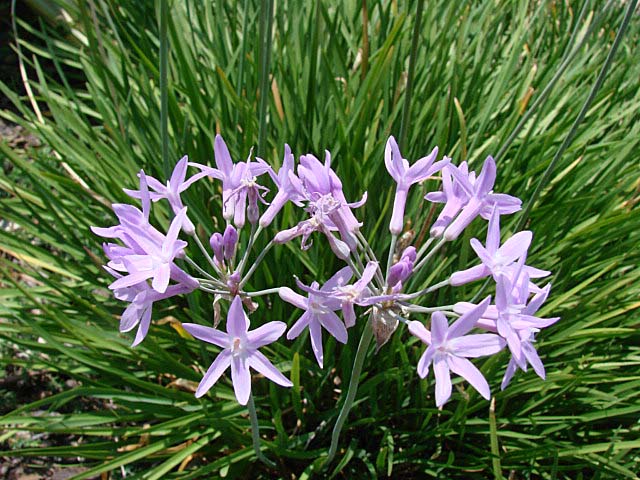
Society Garlic (Tulbaghia violate), grows to 24" high and 10" wide, native of South Africa. Highly versatile plant that produces showy clusters of violet flowers. In Austin, San Antonio and Houston, this plant is evergreen. It tolerates full sun, filtered sun or shade. It blooms better with filtered sun. For Austin and Hill Country area residents, this baby is deer resistant.
Society Garlic has a clumping growth habit and feature long grass-like leaves that smell like garlic when crushed.
Society Garlic
For Full Sun
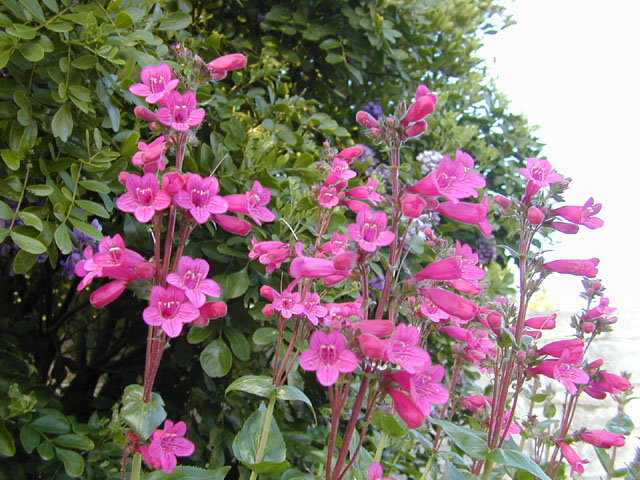
Hill Country Penstemon is a can't miss selection for anyone living on the Edwards Plateau. It's a butterfly and hummingbird magnet and stands out in the landscape with its long towers with two inch scarlet colored blooms. Moderately deer resistant and drought tolerant.
Hill Country Penstemon
VERSATILE GROUNDCOVER
Horse Herb is a favorite selection of mine for projects we do in the Austin area where there are numerous mature Live Oaks or similar large trees in the landscape with large expansive beds in place due to the difficulty in maintaining turf there.
Horse Herb is native to Texas, does well in dry conditions, shaded areas, and even produces small yellow flowers throughout. It grows to only a few inches high but expands and creates an extensive root system that is great for solving erosion issues. It is self-seeding so if winters get unusually cold, Horse Herb will reappear in spring. It will tolerate full sun, partial sun and does well in full shade. And - the deer leave it alone.
Horse Herb
_small.jpg)
I'll open the forum up for additional questions. No question is too simple or too complicated.
We've recently begun a Facebook page for Green Thumb, would appreciate you "liking" us!
https://www.facebook.com/mygreenthumblandscape
Patience.
Most turf is still dormant. Turf in San Antonio and Houston might be turning green right now, especially St Augustine. But it's not actively growing. The nights are still too cold for that to happen. There's no point in putting down fertilizer if it's not going to cause growth. Plus, you put your turf at risk because conditions are cool and damp, ripe for fungus. The nitrogen in fertilizer enhances the growth of fungus.
April 1 is a good date for DFW folks. Last week of March for Austin, San Antonio and Houston folks.
Q&A WITH HORNSPORTS MEMBERS
1. Looking for suggestions for colorful perennials to put in two large flower beds in the Austin area. The beds get very little sunlight through out the course of the day. Your thoughts?
Heavy shade? Try the Society Garlic, shown in my feature plants below. They enjoy the shade, are evergreen in Austin, SA and Houston, and the deer leave them alone! Beyond that, shade poses some challenges for those trying to achieve color. You can turn to Variegated Pink Ginger, Turk's Cap, Dianella (variegated flax lilly), Oxalis (crimson clover) and for seasonal flowers, go with New Guinea Impatiens.
Oxalis
2. When should I put on pre-emergent fertilizer on my lawn?
A - Pre emergent and fertilizer are two different products entirely and should not be applied at the same time. It won't hurt to apply them together, but because of timing, they are not. Pre emergent should have been applied back in mid-February, but it's always better to be late than to not apply at all. Fertilizer should go down around first of April and then again in June and again in September. Pre emergent goes down in February, August and November.
3. I forgot to bring in my Hawaiian Ti plants last night and there was ice all over the leaves the next morning. Will the leaves die now? This will mortally P... me off as we grew these plants from sticks we bought on our last Hawaiian trip.
Mahalo is a no no.
You'll likely lose those leaves that were "burnt" by the ice. As long as the stalk and roots were not damaged, you should see a fairly quick grow back once temperatures get a little higher than they are now. If the ice was only on there for a day, then damage will be minimal. If it was there multiple days, then it could drop them all.
4. What's better: standard chemical fertilizer like Scott's etc or spreading manure over the yard? Or maybe another way to express the question; is the additional work to top dress with manure worth the time and effort?
I don't recommend topdressing with manure. It will burn the lawn up, too much "fresh" nitrogen. I do recommend topdressing with a COMPOSTED manure, where the stuff is broken down and the nitrogen content is way down. You're looking to replenish trace minerals and nutrients with compost, not really fertilize. Chemical fertilizer products like Scotts are time-released by design, therefore they will not burn the lawn unless you just starve it of water after applying. If you're looking for an organic option, there's corn gluten which has about a 9% nitrogen content.
5. What in your opinion is the biggest waists of money at the yard store and or the biggest mistakes you see yard owners do over an over again.
If this is a regional question Im in Austin.
There are so many
. . . A lot of mistakes start right there in the Garden Dept of Lowes or Home Depot. The man/woman helping you and giving you advice was working the plumbing dept. the week before. I also would not buy a plant or tree from either place. They are always smaller than everyone else's plants because they will take a 1 gallon plant, put it in a 3 gallon container and sell it as a 3 gallon plant instead of a 1 gallon plant. Doing this, they can afford to give you a money-back warranty as most folks just won't go back with a dead plant anyway."Winterizer" and the concept of it is a total farce. Scott's once made a product it named "Winterizer." They were sued because it was found that a lawn does not technically need to be "winterized" with fertilizer. Dormant grass does not feed or intake anything and by the time spring rolls around, that November application is long gone. So Scott's lost and was made to take the product off the shelf. Since then, they've re-introduced "winter guard" and are using the higher content of phosphate as the effective ingredient that helps turf during the Winter. But again, turf does not intake while dormant.
A product sold at Austin area Lowes and Home Depots, can't think of the name but there's a honey bee on the label - called "Landscape Mix" is a terribly inferior product. I would not purchase much less plant with it. It is nothing more than ground up mulch. Landscape mix is supposed to be finely ground wood particles mixed in with Perlite.
Those are a few of the wastes of time that I can think of.
6. How much do you charge? I want to pay for something for my parents' front yard, but they live in Gainesville.
We do not offer lawn mowing services in Gainesville. However, I would be open to handling their chemical lawn maintenance as well as projects such as you're suggesting to create or redo a front or back landscape. Send me an email at greenthumbtx@verizon.net and let's discuss.
7. Is there a time to scalp your yard or is that always bad?
I hate the word "scalp." It's just a painful word that implies something bad happened. If you have a Bermuda lawn, you'll want to mow ONE TIME at the lowest level, that would be the FIRST MOW of the season. After that, return to a normal blade height for Bermuda during spring, which would be about 2.5 inches. The reason we do this is to expose the soil level, allowing the sunlight to hit it directly which heats us the first few inches of soil (where the Bermuda roots are located) and causes the grass to come out of dormancy faster.
You do the same with St Augustine, but don't mow it as low as you would Bermuda. A mow of 2" for the first mow of the season will suffice. After that, get to a 3" cut through spring.
St Augustine lawn owners - one of the biggest mistakes I see each year is homeowners keeping their St Augustine short during the heat of the summer. They love the "Carpet" look but unfortunately, it dries the turf out twice as fast and causes the turf to stress, turn yellowish, and become vulnerable to other issues.
From June 1 through Aug. 31, keep your blade height at 3.5" and no shorter. Your turf will be able to keep the water it gets longer, stay emerald green while others do not, live without stress and stand up to pests and disease better. It's just the way this grass is meant to be kept, period.
Bermuda is similar, but not as crucial. It's a native grass to Central and North Texas so it's much more forgiving that way and more drought tolerant. St Augustine is a coastal grass, so it requires more water.
Another item before we leave this subject - take the time here at the beginning of the season to sharpen your mower blade. If you don't know how, take your mower to a mower shop and let the do it for you. Should not cost more than $12-$15 at most. A dull blade will "tear" grass which causes stress. A sharp blade will cut grass, which prompts growth.
FEATURE PLANTS
(I will ocassionally showcase some plants that I think are off the beaten path, but are solid and unique options that might work in your landscape. This is a first in that series)
For Shade
Society Garlic (Tulbaghia violate), grows to 24" high and 10" wide, native of South Africa. Highly versatile plant that produces showy clusters of violet flowers. In Austin, San Antonio and Houston, this plant is evergreen. It tolerates full sun, filtered sun or shade. It blooms better with filtered sun. For Austin and Hill Country area residents, this baby is deer resistant.
Society Garlic has a clumping growth habit and feature long grass-like leaves that smell like garlic when crushed.
Society Garlic
For Full Sun
Hill Country Penstemon is a can't miss selection for anyone living on the Edwards Plateau. It's a butterfly and hummingbird magnet and stands out in the landscape with its long towers with two inch scarlet colored blooms. Moderately deer resistant and drought tolerant.
Hill Country Penstemon
VERSATILE GROUNDCOVER
Horse Herb is a favorite selection of mine for projects we do in the Austin area where there are numerous mature Live Oaks or similar large trees in the landscape with large expansive beds in place due to the difficulty in maintaining turf there.
Horse Herb is native to Texas, does well in dry conditions, shaded areas, and even produces small yellow flowers throughout. It grows to only a few inches high but expands and creates an extensive root system that is great for solving erosion issues. It is self-seeding so if winters get unusually cold, Horse Herb will reappear in spring. It will tolerate full sun, partial sun and does well in full shade. And - the deer leave it alone.
Horse Herb
I'll open the forum up for additional questions. No question is too simple or too complicated.
We've recently begun a Facebook page for Green Thumb, would appreciate you "liking" us!
https://www.facebook.com/mygreenthumblandscape