


Sirhornsalot
**The Official Horn Sports Landscaper and Landscap
- Joined
- Nov 6, 2013
- Messages
- 34,733
March is here and it’s transition time again. Winter is on the way out and the first glimpses of spring are started to show. It’s an exciting time of year in the landscape.
I will address the things to do in March and will welcome any questions from the board.
March and the Live Oak molting season
March is the month where our native Live Oaks will go through a period called “molting†whereby they will dispose of their leaves all the while growing their new ones for the year. The process lasts about three weeks. They are never without leaves but each year I think we are re-amazed at how many leaves a single Live Oak can dump.
Because they are small, they’ll get everywhere. So a more thorough clean up will be required. And they do need to be cleaned up as later they’ll just become a fire hazard, particularly if next to a home.
I encourage the composting or mulching of these leaves. If you’re mulching them, it’s good to blow them out to the middle of the lawn and repeatedly mow over them with a mower with a mulching blade. Once they’re chopped up well, disperse them into the turf or in areas where the soil needs replenishing.
If you choose to compost them, be sure to put into your composting bin in “layers†of dead matter and green matter. This will provide for quicker and more even composting. Composting bins should be wet at least once a week. It’s best to allow rainfall be that weekly watering and use your chlorinated water as a last resort when you don’t get rain. Chlorine can kill many of the microbes and bacteria that are busy composting your materials. So use it at a minimum.
I would advise waiting until after the molting period is finished before you mulch your beds.
Do Not Trim Oaks
Just a quick note, we highly discourage trimming any Oaks during the period of March 1 through June 30. It is during this time when pollens from Oak Wilt are at their peak and thus the disease is spread more easily. It’s fine to trim other types of trees but it is generally better to get it done in early spring so that you’re not putting them under stress during the heat of summer.
Spring fertilization
Homeowners in the San Antonio and Houston areas (and points south of that) can begin applying their spring fertilization during the third week of March. This is a general rule so by all means, go by the weather conditions we have at the time. If winter is still hanging around at that time, bump your application back a week or so. Austin area residents can begin applications during the last week of March while DFW homeowners need to wait until at least April 1. Of course, mother nature has final say.
Stick to the recommended ratio and adjust your spreader accordingly. Too much fertilizer can cause stunting of growth and turf fungus issues. Ratios for most products are found on the back of the bag.
A gardening friend emailed me this past month and asked me what the difference was between a straight fertilizer and a weed/feed. Straight fertilizers do not have a weed killing ingredient mixed in. Weed/feeds have a weed killing ingredient. Most weed/feed products are slow release and thus continue working for at least 90 days or so.
Picking a fertilizer product
Treating a St Augustine lawn with a Weed/Feed designed for Bermuda can have fatal results. Likewise, a St Augustine or Zoysia weed/feed can have detrimental results on Bermuda. So make sure you are selecting the correct product for your lawn. Zoysia lawns should be treated with the same products as St Augustine.
St Augustine lawns do best when the nitrogen ratio is at 15-25 and no higher. All fertilizers have a series of three numbers on the label. That first number is always the nitrogen ratio.
Bermuda lawns can have higher nitrogen ratios, so products that have as much as 37-0-0 can be applied, although something like a 27-32 is sufficient.
For St Augustine/Zoysia lawns, I recommend Fertilome’s St Augustine Weed/Feed. For Bermuda lawns, Scott’s Turfbuilder is hard to beat on the retail side.
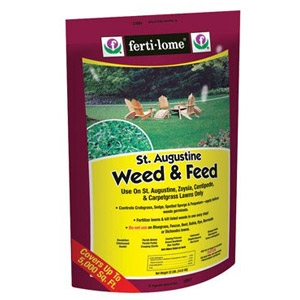
If your lawn is relatively clean (no weeds), you may opt to go with a straight fertilizer. There are many fertilizers on the commercial market that are top performers for certain turf at certain times of year. This is where a landscaper can really help as they have these products available to them. The Triple 18-18-18 Hydromulch fertilizer is about as good as fertilizer gets. Makes lawns really sing and dance.

Bed Fertilization
RIGHT NOW is the time to be applying a mild fertilizer to your beds. You will want to choose a granular product that is time released. If you have a rain event coming, it would be beneficial to apply shortly before its arrival (unless its a deluge). But now is the time to be getting those nutrients in the soil as we’re now only weeks away from the emergence of spring. This will give your beds a great start as what they want is already in the soil right when they want it.
Apply sparingly throughout the beds by hand. Wash hands after applying or wear gloves.
I have all products available to me on both retail and professional side of the business. However, when it comes to bed fertilization I’ve had great success using an ordinary retail product found at Lowes. Sta-Green makes a version of it and also Ultra-Green makes a version of it. Comes in 5 lb bags and runs about $7 a bag. It’s called Azalea Food 10-5-4. While it’s designed for azaleas, it has similar positive response from all plants, including palms. It’s a great bang for the buck.
The Organic Guy
If you’re one who sticks with the organic side of gardening/landscaping, I don’t forget you. Now is the time when you should apply a dried molasses and then by third week of March, apply Corn Gluten (as a fertilizer alternative). The molasses will give your lawn’s insect population a head start. The goal being creating a self-sufficient harmony in the insect world within your fence borders. The molasses will attract the predator insects that prey on the pest insects.
This would also be a good time to drench your beds with Garret Juice (a product from Howard Garrett, the Dirt Doctor) (www.dirtdoctor.com)
Shared Question
Question from fellow gardener – “I just applied pre emergent to my lawn for the first time three weeks ago. Now, I have a bunch of weeds. What givesâ€
Answer – Pre emergent is a product that is not an immediate effect. It takes ongoing applications before the cumulative effect to be realized. So if you’ve just applied it for the first time, I’d expect you’d see a improved version next year at the same time. By year two, you should be almost weed-free.
Weeds
Right now, some of you may have lawns that are under attack by early spring weeds. One of those weeds is likely Poa Annua. There are approximately 175 different varieties of this weed. You can have as many as 50 of those varieties found in one single lawn. And the kicker is – there is no chemical answer for all 175 types. Yet, this is the weed you’re likely seeing now as it’s a cool season weed. (see picture)

Note the seeds at the ends of each stem of the mature Poa Annua
A product called Gordon’s Speed Zone will kill weeds in BERMUDA lawns during the cold/cool season. Regular weed killers will not work until temperatures are at or above 85 degrees. Do NOT use Speed Zone in a St Augustine or Zoysia lawn. But it does work well in Bermuda and will kill many varieties of Poa Annua. It can be purchased on Amazon.
You should discontinue use of Speed Zone once temperatures are at or above 85 as it will leave ugly burn marks in the lawn.
The floor is open to questions! Fire away!
I will address the things to do in March and will welcome any questions from the board.
March and the Live Oak molting season
March is the month where our native Live Oaks will go through a period called “molting†whereby they will dispose of their leaves all the while growing their new ones for the year. The process lasts about three weeks. They are never without leaves but each year I think we are re-amazed at how many leaves a single Live Oak can dump.
Because they are small, they’ll get everywhere. So a more thorough clean up will be required. And they do need to be cleaned up as later they’ll just become a fire hazard, particularly if next to a home.
I encourage the composting or mulching of these leaves. If you’re mulching them, it’s good to blow them out to the middle of the lawn and repeatedly mow over them with a mower with a mulching blade. Once they’re chopped up well, disperse them into the turf or in areas where the soil needs replenishing.
If you choose to compost them, be sure to put into your composting bin in “layers†of dead matter and green matter. This will provide for quicker and more even composting. Composting bins should be wet at least once a week. It’s best to allow rainfall be that weekly watering and use your chlorinated water as a last resort when you don’t get rain. Chlorine can kill many of the microbes and bacteria that are busy composting your materials. So use it at a minimum.
I would advise waiting until after the molting period is finished before you mulch your beds.
Do Not Trim Oaks
Just a quick note, we highly discourage trimming any Oaks during the period of March 1 through June 30. It is during this time when pollens from Oak Wilt are at their peak and thus the disease is spread more easily. It’s fine to trim other types of trees but it is generally better to get it done in early spring so that you’re not putting them under stress during the heat of summer.
Spring fertilization
Homeowners in the San Antonio and Houston areas (and points south of that) can begin applying their spring fertilization during the third week of March. This is a general rule so by all means, go by the weather conditions we have at the time. If winter is still hanging around at that time, bump your application back a week or so. Austin area residents can begin applications during the last week of March while DFW homeowners need to wait until at least April 1. Of course, mother nature has final say.
Stick to the recommended ratio and adjust your spreader accordingly. Too much fertilizer can cause stunting of growth and turf fungus issues. Ratios for most products are found on the back of the bag.
A gardening friend emailed me this past month and asked me what the difference was between a straight fertilizer and a weed/feed. Straight fertilizers do not have a weed killing ingredient mixed in. Weed/feeds have a weed killing ingredient. Most weed/feed products are slow release and thus continue working for at least 90 days or so.
Picking a fertilizer product
Treating a St Augustine lawn with a Weed/Feed designed for Bermuda can have fatal results. Likewise, a St Augustine or Zoysia weed/feed can have detrimental results on Bermuda. So make sure you are selecting the correct product for your lawn. Zoysia lawns should be treated with the same products as St Augustine.
St Augustine lawns do best when the nitrogen ratio is at 15-25 and no higher. All fertilizers have a series of three numbers on the label. That first number is always the nitrogen ratio.
Bermuda lawns can have higher nitrogen ratios, so products that have as much as 37-0-0 can be applied, although something like a 27-32 is sufficient.
For St Augustine/Zoysia lawns, I recommend Fertilome’s St Augustine Weed/Feed. For Bermuda lawns, Scott’s Turfbuilder is hard to beat on the retail side.
If your lawn is relatively clean (no weeds), you may opt to go with a straight fertilizer. There are many fertilizers on the commercial market that are top performers for certain turf at certain times of year. This is where a landscaper can really help as they have these products available to them. The Triple 18-18-18 Hydromulch fertilizer is about as good as fertilizer gets. Makes lawns really sing and dance.
Bed Fertilization
RIGHT NOW is the time to be applying a mild fertilizer to your beds. You will want to choose a granular product that is time released. If you have a rain event coming, it would be beneficial to apply shortly before its arrival (unless its a deluge). But now is the time to be getting those nutrients in the soil as we’re now only weeks away from the emergence of spring. This will give your beds a great start as what they want is already in the soil right when they want it.
Apply sparingly throughout the beds by hand. Wash hands after applying or wear gloves.
I have all products available to me on both retail and professional side of the business. However, when it comes to bed fertilization I’ve had great success using an ordinary retail product found at Lowes. Sta-Green makes a version of it and also Ultra-Green makes a version of it. Comes in 5 lb bags and runs about $7 a bag. It’s called Azalea Food 10-5-4. While it’s designed for azaleas, it has similar positive response from all plants, including palms. It’s a great bang for the buck.
The Organic Guy
If you’re one who sticks with the organic side of gardening/landscaping, I don’t forget you.
Now is the time when you should apply a dried molasses and then by third week of March, apply Corn Gluten (as a fertilizer alternative). The molasses will give your lawn’s insect population a head start. The goal being creating a self-sufficient harmony in the insect world within your fence borders. The molasses will attract the predator insects that prey on the pest insects.This would also be a good time to drench your beds with Garret Juice (a product from Howard Garrett, the Dirt Doctor) (www.dirtdoctor.com)
Shared Question
Question from fellow gardener – “I just applied pre emergent to my lawn for the first time three weeks ago. Now, I have a bunch of weeds. What givesâ€
Answer – Pre emergent is a product that is not an immediate effect. It takes ongoing applications before the cumulative effect to be realized. So if you’ve just applied it for the first time, I’d expect you’d see a improved version next year at the same time. By year two, you should be almost weed-free.
Weeds
Right now, some of you may have lawns that are under attack by early spring weeds. One of those weeds is likely Poa Annua. There are approximately 175 different varieties of this weed. You can have as many as 50 of those varieties found in one single lawn. And the kicker is – there is no chemical answer for all 175 types. Yet, this is the weed you’re likely seeing now as it’s a cool season weed. (see picture)
Note the seeds at the ends of each stem of the mature Poa Annua
A product called Gordon’s Speed Zone will kill weeds in BERMUDA lawns during the cold/cool season. Regular weed killers will not work until temperatures are at or above 85 degrees. Do NOT use Speed Zone in a St Augustine or Zoysia lawn. But it does work well in Bermuda and will kill many varieties of Poa Annua. It can be purchased on Amazon.
You should discontinue use of Speed Zone once temperatures are at or above 85 as it will leave ugly burn marks in the lawn.
The floor is open to questions! Fire away!
Last edited by a moderator: