



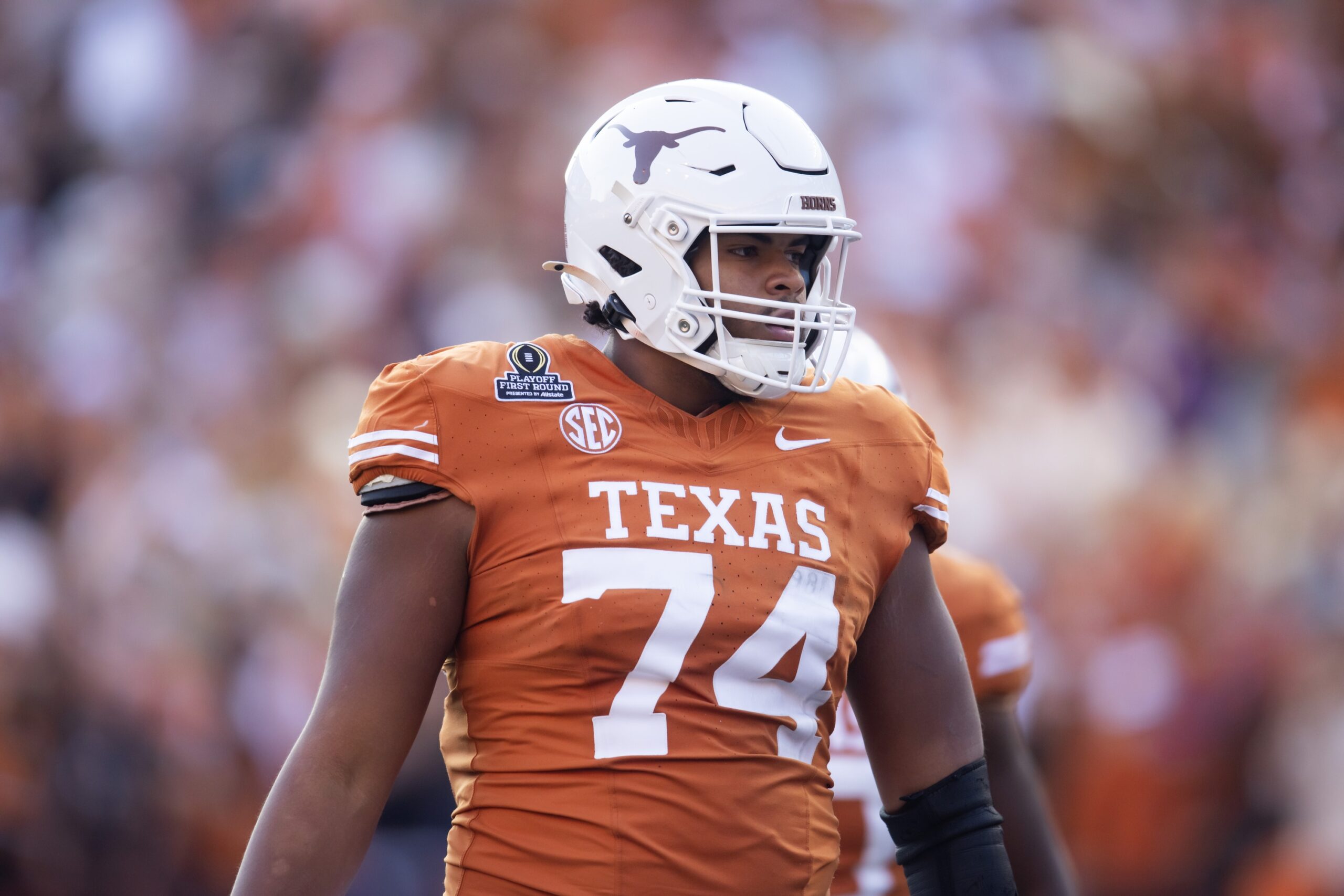
Every season, college football brings with it a mix of excitement and uncertainty. Fans tune in for the big plays, the rivalries, and the chance to see future stars develop. However, injuries are becoming something that every player seems to fall victim to, with Trevor Goosby suffering from one to his hands.
Research from one NCAA Division I football program over 17 seasons found an average of 9.9 hand and wrist injuries per year. Interestingly, the occurrence rates were 3.3 injuries per 1,000 AE (athlete exposure) hours during games, versus 1.2 per 1,000 during practice. Athletes are pushing their bodies to the limits during games, and that ends up affecting their health and not just team performance. Let’s explore further.
What’s Happening With Trevor Goosby?
Heading into the season opener against Ohio State, Texas Longhorns junior left tackle Trevor Goosby carried more than just expectations. He carried a hand injury that cast a shadow over his availability.
Head coach Steve Sarkisian initially played it down, suggesting the malaise wouldn’t keep Goosby off the field. Still, Pete Nakos revealed he’d be a game-time decision, and Orangebloods added he might suit up with protective gear, though not at full strength.
Despite the uncertainty, Goosby did take the field, bandaged but determined to protect the Longhorns’ front. This was especially crucial after losing reserve tackle Andre Cojoe to a season-ending injury. His status underlined one of college football’s most overlooked truths: the offensive line’s health is the backbone of every championship run.
When even a single starter is hobbling, particularly at a critical position along a thin lineup, it raises immediate concerns about both individual effectiveness and cascading team vulnerabilities. More importantly, it raises questions about injury rates and treatment.
The Persistent Health Risks and Indirect Long-Term Concerns
Football is a game built on contact, and with contact comes risk. Offensive linemen like Goosby are especially prone to hand fractures, ligament strains, and joint sprains. These are the result of constant trench battles in the line of scrimmage.
The fact is that the trend of repeated injuries doesn’t just begin at the college level of football. It starts even in High School. The CDC reports that 70% of sports-related emergency department visits for concussions and TBIs are among people aged 17 and younger. Unsurprisingly, tackling was responsible for 63% of these concussions.
Of course, players also face a wide spectrum of injuries. These include:
- Acute injuries like ACL tears or concussions can change a season overnight.
- Overuse injuries, such as tendonitis or stress fractures, are common in positions that take repetitive strain.
- Chronic conditions like back problems or arthritis slowly accumulate over the years.
Sometimes, health risks are also present in the treatment process, as seen in ethylene oxide lawsuits (EtO). This is a chemical gas widely used to sterilize medical equipment that can’t handle high heat, including surgical instruments, rehab devices, and catheters.
While it plays an essential role in keeping equipment safe from infection, EtO has a darker side: the EPA and CDC both classify it as a carcinogen. One study found that higher ethylene oxide emissions near residential areas were associated with an increased risk of developing in situ breast cancer, particularly among those living within 3 kilometers of emission sources.
This is the kind of risk that players might be facing. As TorHoerman Law notes, long-term exposure has increased the likelihood of lymphoma, leukemia, and other types of cancers.
For athletes like Goosby or Cojoe, recovering from injuries, every surgery, every round of physical therapy, every device that comes pre-sterilized may at some point have been treated with EtO.
What’s the Best Way to Protect the Next Generation of Athletes?
When fans watch college football on Saturdays or cheer on their favorite football team, they’re watching the result of years of training, sacrifice, and resilience. Today, athletic departments have made major strides in protecting players. Helmets are stronger, concussion protocols are stricter, and training regimens are more sophisticated than ever.
The University of Texas, like other powerhouse programs, invests heavily in sports medicine, nutrition, and mental health resources. However, there’s always room for improvement. One interesting strategy would be data-driven monitoring.
For instance, one review published in BMC Sports Science highlighted the increasing use of wearable technologies in sports settings for training adaptation and injury prevention. Researchers were able to use accelerometers, GPS, and force plates to monitor athlete performance, which appears to potentially reduce injury risks.
This involves tracking everything from player workloads to hydration levels in order to catch early signs of fatigue before they spiral into torn ligaments. It’s definitely one of the more promising options that’s going to be used extensively from here on.
Frequently Asked Questions
1. What are the top 3 football injuries?
The three most common football injuries are concussions, knee injuries (like ACL tears), and ankle sprains. These happen a lot because of all the fast cuts, heavy hits, and awkward landings. Even though athletes train hard, these weak spots get tested constantly on the field.
2. What is the hardest sports injury to recover from?
An ACL tear is usually considered the toughest to bounce back from. Recovery can take 9–12 months, and even then, some players never feel the same confidence in their movements again. It’s not just physical — it’s also about regaining mental trust in your body.
3. How serious are football injuries?
Football injuries range from minor bruises to life-changing conditions like concussions or spinal injuries. While many heal up with rest and rehab, the serious ones can cut careers short or impact long-term health. It’s why injury prevention and recovery programs are such a big deal in college sports.
Ultimately, the conversation around injuries in football shouldn’t stop at the sidelines. The challenge for universities, medical staff, and governing bodies is to treat athlete safety as an evolving responsibility, not a finished project. Progress is being made, but the next steps will decide whether players can trust not only their bodies, but also the systems built to protect them.



![Looking ahead to the UTEP game & Recapping the San Jose State Win [VIDEO]](https://hornsports.com/wp-content/uploads//2025/09/USATSI_27017185_168380999_lowres-75x75.jpg)