


Sirhornsalot
**The Official Horn Sports Landscaper and Landscap
- Joined
- Nov 6, 2013
- Messages
- 34,957

How does a Super El Niño affect your landscape and garden?
By now, most all of you have heard about the “Super” El Niño that begins this month and is supposed to last into next Spring. In fact, one can say its effects have already begun with the remnants of Category 5 Hurricane Polo breaking our almost three month drought.
How exactly does this affect our weather and also our landscapes and gardens?
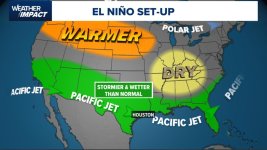
Typically, El Niño shifts the jet stream farther south, and causes wetter and cooler conditions to the southern United States while the northern US tends to be warmer and drier. The wetter and cooler conditions include the North Texas region.
But this El Niño is being billed as the strongest ever on record. Increased rainfall, perhaps record-setting rainfall, along with periods of frozen precipitation when we go into Winter, are likely outcomes. A similar, but weaker El Niño occurred in the Fall of 2015 and lasted through the Winter of 2016. That period saw us received 13 inches over three months, an example of how impactful this can be.
What do we need to prepare for this weather phenomenon in the landscape and how do we do that?
1. With increased rainfall, severe thunderstorms with driving rain, the drainage on your property will be tested.
If you have a drainage system on your property, you will want to make sure they stay clear of debris, leaves and grass clippings. There is nothing worse than spending a lot of money on a drain and then it not work when you need it most.
Clear your drain basins, drain grates of all debris. You may even want to test your drain by using your water hose on full blast, sticking it into the different surface drains and drain basins. While doing this, go to the drain exit and note the flow of the water coming out.
If the flow is weak, you need to clean the drain. You can attach a high pressure hose nozzle on the hose and feed the hose, three feet at a time, into the drain pipes as far as you can. You should observe debris coming out of the exit. When your proper water flow is restored, you’re done.
Meanwhile, you should ask your lawn crew to start maintaining the drain basins and surface drains to keep them free of debris and there no is nothing to restrict the flow of water.
If you don’t have a drain system and feel like you may need one, contact your landscape professional and ask for an estimate.
Eleven of the 21 wettest years on record for the DFW Metroplex have occurred during El Niño years. A Super El Niño certainly has the potential to be added to the record books.
2. With the increased possibilities for snow during this period, it would be good to have mulch installed to your beds. Mulch will help insulate your beds, providing protection for the roots of your shrubs, perennials and trees.
In most cases, shrubs such as Hollies, boxwoods, and Nandinas tend to perform fine during cold weather events. But it is still important to help them along. It is best to wait until the Fall leaves are finished dropping before mulching, however.
It is also a great idea to purchase freeze blankets for your shrubs and perennials. Make sure you select a product that is white which allows light through. We don’t want anything to be kept in a cold, dark place. The white blankets help plants continue to photosynthesize by allowing light through.
Also purchase “lawn staples,” sold at most nurseries, to hold down your blankets effectively.
Freeze blankets help keep the temperatures warmer beneath the blanket and prevents ice from forming on the leaves.
3. Erosion. With climatologists expecting hard rain, downpours and thunderstorms, the likelyhood of erosion increases dramatically. What is at threat are the bare or thin areas of your lawn and landscape. Topsoil will be eroded away, making it more difficult for grass and plants to grow.
If you have areas that are bare or thin, it would be a good idea to lay sod in those areas to prevent the soil from washing away the topsoil, particularly if your terrain has a decline involved.
In suburban North Texas in particular, the homes are built with hard declines on each side, making erosion especially problematic for the home’s foundation.
If you can’t grow grass on those sides, which is typical, then you may consider installing a small to medium sized river rock or other decorative rock. During such an install, weed fabric is placed down prior to installing the rock. This fabric, combined with the weight of the rock, will hold your soil in place.
Other effects to expect
Most of the North Texas region has been without rainfall since July 15. Our soils are parched. The black clay soil has huge cracks all over. Even our native trees have suffered tremendously during this hot and rainless spell.
A good soaking rain is what we need to rebound from the stress of the summer, but what is expected will likely be hard downpours. We’ll still see recovery from suffering trees, landscape plants and lawns and even our soil.
This month!

Time to plant Pansies and Ornamental Kale!
Get your Pansies and ornamental Kale planted as early as you can this month! One thing I cannot stress enough is getting them planted in early October. The reason why is October still gives us warm days with which the Pansies’ root systems are able to grow and expand.
The result is bigger, healthier plants and more blooms. Do not wait until November!
Make sure you give them a dose of Pansy food a week after planting.
Damaged lawns
Many North Texas lawns were struck by Chinch bugs and Sod Web Worms during our record-setting heat this summer. With rainfall relief and drop in temperatures, the damage is likely finished.
If you have a Bermuda lawn that was hit by these insects, do not expect much recovery despite the rainfall we will get this month. All plants and trees, including your turf, are preparing to go dormant for the Winter. Growth will slow and spreading will be minimal during this time.
Even still, Bermuda will recover on its own. St. Augustine and Zoysia turf, however, will need to be re-sodded in the damaged areas. It won’t recover without help. You can install sod successfully any month during Fall and Winter, despite some thinking otherwise. Even when the sod is dormant.