

Sirhornsalot
**The Official Horn Sports Landscaper and Landscap
- Joined
- Nov 6, 2013
- Messages
- 34,214
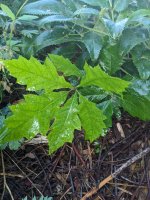
What are these things growing in my beds?
If you’re a homeowner with a landscape in North Texas, you know this problem all too well.
At first, you’re not sure what it is. It’s growing in your beds, right next to a shrub. Then later you see another one. And then another one.
Quite often, we don’t understand what is happening until these things are large and healthy and have leaves.
I’m talking about tree saplings, also known as “volunteers.” They are called so because they are not actually planted or intended to exist in the landscape. They come up from floating tree seeds or tree seeds that have been blown in by the wind. They are also brought in by birds and squirrels.
Ever notice how a pasture often has trees up and down the fence lines? Birds, who fly in and make a pit stop on top of a fence, often drop seeds they’ve collected onto the ground below. A year or so later you have a sapling growing on the fence line.
Beneath the fence is grass that doesn’t get mowed like the rest of the pasture. This grass along the fence grows taller and creates a sort of net for blowing seeds. They blow into the taller grass and tumble down to the soil below.
But in landscape beds, you can find yourself in trouble, fast, if you do not control the saplings.
Many of the saplings are tree species that get quite large. No large tree should be allowed to grow that close to your home’s foundation. Some of the more common “volunteers” in North Texas are Oak trees of many varieties, Cedar Elms, Eastern Red Cedar, Hackberry Trees and Sumac Trees,
Some of these will grow up around AC units, which will become problematic for he units as we’re not supposed to allow any type of growth within three feet of AC units, so that they can breath, so to speak.
You can chemically kill saplings in areas where you do not have plants, shrubs or trees. We DO NOT spray saplings with any type of chemical when the saplings are located in shrub and flower beds. You run the risk of those chemicals ending up killing your plant stock as they may drift in the bed when watered or by rain.
“I have some saplings in my landscape beds, what do I do?”
If your saplings are relatively small, say 10 inches tall or below that, you can remove them by hand by grabbing the trunk and pulling directly upward. You will want to wear gloves when doing this. But first, you will want to water the area well before beginning, making the soil softer and the sapling pulls up much easier.
If the sapling is more than a foot high, you will likely not be able to pull it up. Roots grow fast and become extensive. In that case, you will want to cut the tree sapling even with the soil or just above. Do not try to chemically kill in a flower bed or shrub bed. The chemical will drift and the roots are intermingled with the roots of your shrubs. These things often grow up only inches away from the trunk of a shrub.
Once you’ve cut the sapling at ground level, you will also need to plan on revisiting the location every couple of weeks to see if the tree is re-emerging. If that is true, then repeat the cut to soil level. Eventually, the sapling will become starved of sunlight and will die. Another way of stopping it from re-emerging is to simply put a large, decorative rock on top of it.
I would recommend approaching this task with either hand snips, lopers, or a hand saw. Do not use a chain saw unless the tree’s size requires it.
The sooner you can pull them once they start growing, the easier this problem is solved. Wait until they get larger, then you will have to spend more time eliminating the problem.
June’s TO–DO list
1. Raise your lawnmower blade this month in anticipation of higher temperatures and less rainfall. Turf that is allowed to stay at or above 3.5 or 4 inches will be healthier, greener throughout the hot months.
2. Set your sprinkler system to begin at 10 or 11 pm at night. There is no danger of lawn fungus during the hot months, so no worries there. Watering at night has its advantages, namely offering ample time for plant/water to be together before the next day’s sun and heat begin evaporation again. Plants are able to absorb more water because of the extra hours without evaporation.
On Labor Day, at the end of summer, we will change this to a morning start to avoid fungus issues which would show up in Fall.
3. Apply your grub control on the lawn and in the beds by the middle of the month.
4. Apply your second round of fertilizer to your lawn around the middle of the month. You can apply both the fertilizer and the grub control to the lawn on the same day. Water the products in for two nights in a row. Make sure you do not get the lawn fertilizer in the beds. You may have to hand-toss in some areas where space is tight.
Do not fertilize your beds until Fall. Now that temperatures are getting higher, fertilizing would create some stress on the bed plants due to the heat. Fertilizer makes plants thirsty. The lawn, of course, has more tolerance and requires the feeding.